

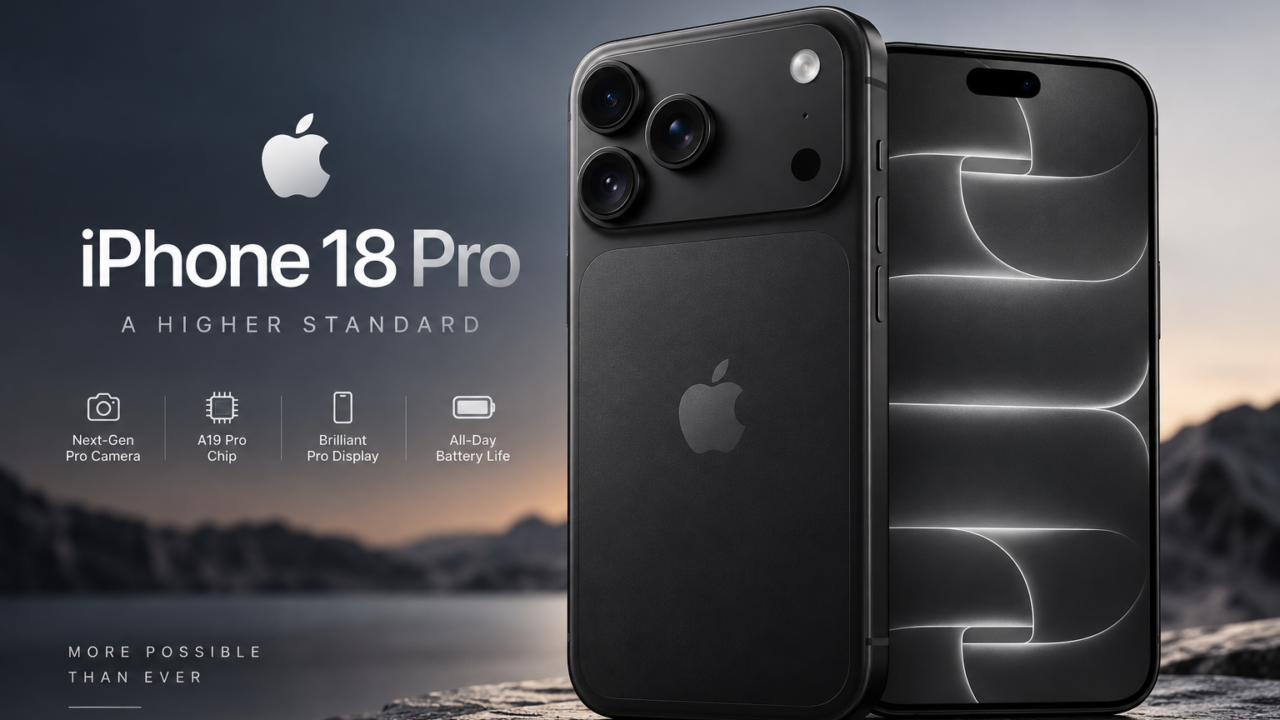
SMARTPHONES | Review | 2026
- iPhone 18 Pro (1TB) Review 2026: A20 Pro, Variable Aperture Camera & Price in India
- Quick Verdict
- Key Specifications
- Design & Build Quality
- Display
- Performance
- Gaming Performance
- Camera
- Daylight Camera
- Portrait Camera
- Night Photography
- Ultrawide Camera
- Selfie Camera
- Video Recording
- Software & Features
- Battery Life & Charging
- Connectivity
- Pros & Cons
- Price & Availability in India
- Competitors & Alternatives
- Who Should Buy?
- Who Should Skip?
- Final Verdict — Is the iPhone 18 Pro (1TB) Worth Buying?
- Frequently Asked Questions
- Does the iPhone 18 Pro support a physical SIM card in India?
- What makes the camera different this year?
- Is 1TB storage overkill for most users?
- Does it support fast charging out of the box?
- How does the A20 Pro compare to last year’s chip?
iPhone 18 Pro (1TB) Review 2026: A20 Pro, Variable Aperture Camera & Price in India
The iPhone 18 Pro arrives in India as Apple’s most significant internal overhaul in years, built around the new A20 Pro chip on a 2nm process and, for the first time on any iPhone, a mechanical variable-aperture main camera. This 1TB Black review unit sits at the top of the storage lineup, aimed at creators, professionals, and buyers who never want to think about storage again.
According to Apple’s official India specifications, the iPhone 18 Pro pairs its redesigned thermal architecture — a vapour chamber with roughly triple the cooling surface area of its predecessor — with a 6.3-inch Super Retina XDR display capable of 3,000 nits of peak outdoor brightness, along with battery life Apple describes as the longest ever on a compact Pro iPhone.
This review covers everything based on the manufacturer’s official specification sheet: design, display, real-world performance expectations, the reworked camera system across daylight, portrait, night, ultrawide, selfie and video use cases, battery life, connectivity, and whether the 1TB variant’s steep India price of ₹2,39,900 is justified.
Where relevant, insights from Indian tech reviewers who have gone hands-on with the iPhone 18 Pro and Pro Max have also been factored in, particularly around real-world camera behaviour and the India pricing conversation, to keep this review grounded and human rather than purely spec-sheet driven.

Quick Verdict
Based on the official specification sheet, the iPhone 18 Pro represents one of Apple’s biggest under-the-hood upgrades in recent memory — a new 2nm A20 Pro chip, a genuinely reworked camera system with real optical depth control, and battery life that finally feels proportionate to how people actually use their phones all day.
The 1TB storage configuration reviewed here is squarely aimed at creators shooting ProRes video or ProRAW photos who don’t want to manage storage constantly, and at that end of the lineup, the iPhone 18 Pro reads as a genuinely future-proof purchase on paper.
The trade-off is price — India buyers are paying a meaningful premium over the previous generation, and Apple has not offered a specific justification for the increase beyond general cost pressures. Buyers should weigh whether the chip, camera, and battery upgrades are worth that jump for their own usage pattern.
Overall, this is a phone built for people who already live in the Apple ecosystem and want the best version of that experience currently available, rather than a phone designed to win over first-time iPhone buyers purely on price.
Key Specifications
According to Apple’s official India specifications page, the iPhone 18 Pro (1TB, Black) combines the new A20 Pro chip with a 48MP Pro Fusion triple camera system, a 6.3-inch ProMotion OLED display, and India pricing that starts at ₹1,64,900 for the base 256GB variant, rising to ₹2,39,900 for the 1TB configuration reviewed here.
| Specification | Details |
| Model | Apple iPhone 18 Pro (1TB, Black) |
| Chip | Apple A20 Pro — 2nm process, 6-core CPU (2 performance + 4 efficiency cores), 7-core GPU with Neural Accelerators, dual 16-core Neural Engine |
| Display | 6.3-inch Super Retina XDR OLED, 2622 x 1206 resolution at 460ppi, ProMotion up to 120Hz, 3,000 nits peak outdoor brightness |
| RAM | 12GB |
| Storage | 1TB (non-expandable) |
| Rear Camera | 48MP Fusion Main (variable aperture f/1.48-f/4.0) + 48MP Fusion Ultra Wide + 48MP Fusion Telephoto (100mm, 4x optical, tetraprism) |
| Front Camera | 18MP Center Stage, f/1.9 aperture |
| Battery | Typical use up to 23 hours; up to 34 hours video playback; 60W-capable fast charging, 50% in ~15 minutes |
| Charging | USB-C (USB 3, up to 10Gbps), MagSafe up to 25W, Qi2 wireless charging up to 25W |
| Build | Aluminium unibody, Ceramic Shield 2 front, Ceramic Shield back, IP68 rated |
| Operating System | iOS 27 |
| Connectivity | 5G (sub-6GHz), Wi-Fi 7, Bluetooth 6, Apple N1 chip, Apple C2 modem, UWB 2, NFC |
| Colours | Black, Silver, Glacier, Burgundy |
| Weight | 211 grams |
| Price in India (1TB) | ₹2,39,900 (MRP, official Apple pricing) |
Design & Build Quality
According to Apple, the iPhone 18 Pro retains an aluminium unibody design with Ceramic Shield 2 on the front and a Ceramic Shield back panel, continuing the durability-focused construction introduced in recent generations. The overall silhouette looks familiar at a glance, with most of this year’s changes happening beneath the surface.

The device measures 150.0mm in height, 71.9mm in width, and 8.75mm in depth, weighing 211 grams according to official measurements — marginally heavier than some previous-generation Pro models, largely due to the redesigned internal thermal architecture and larger battery.
Apple’s official specifications confirm an IP68 rating, meaning the iPhone 18 Pro is rated for resistance to dust and water at depths up to 6 metres for up to 30 minutes under laboratory test conditions. The company notes that splash and water resistance are not permanent conditions and may decrease with normal wear over time.
On sustainability, Apple states the iPhone 18 Pro and Pro Max are built with 40% recycled content overall, including 85% recycled aluminium in the enclosure and 100% recycled cobalt in the battery, positioning this generation as part of the company’s broader Apple 2030 carbon-neutral goals.
Display
The iPhone 18 Pro features a 6.3-inch Super Retina XDR all-screen OLED display with a resolution of 2622 x 1206 pixels at 460ppi, according to Apple’s official specifications. ProMotion technology enables adaptive refresh rates up to 120Hz, and the display supports an Always-On mode alongside HDR and True Tone.
Brightness figures are notably strong on paper: Apple lists 1,000 nits typical maximum brightness, 1,600 nits peak brightness for HDR content, and an impressive 3,000 nits peak brightness specifically for outdoor visibility — a figure that should make the screen comfortably legible even under harsh Indian sunlight.
The panel also carries a fingerprint-resistant oleophobic coating and an anti-reflective coating, both aimed at keeping the display clear and glare-free during outdoor use. Apple’s Dynamic Island continues to house the front camera and Face ID sensors within the display area, and this year it has reportedly been made physically smaller without moving the components under the panel.
Wide colour (P3) support and a 2,000,000:1 typical contrast ratio round out the display specifications, positioning this panel among the most capable mobile displays currently available on paper, according to the manufacturer’s own figures.
Performance
At the heart of the iPhone 18 Pro is the new Apple A20 Pro chip, built on a 2nm manufacturing process — a first for Apple silicon. According to the official specifications, it features a 6-core CPU with 2 performance cores and 4 efficiency cores, a 7-core GPU with Neural Accelerators, and hardware-accelerated ray tracing support.

A dual 16-core Neural Engine handles on-device AI processing, which Apple says doubles last year’s on-device AI throughput — relevant for the growing set of Apple Intelligence features running locally on the device rather than through the cloud.
Independent hands-on testing reported by international tech reviewers has found the A20 Pro’s CPU performing between roughly 22-27% faster than the previous generation’s chip, with GPU gains landing between 40-45% faster, based on published benchmark comparisons — a larger year-over-year jump than many expected.
Much of this performance gain is attributed to Apple’s redesigned vapour chamber cooling system, which the company states has roughly triple the surface area of the previous generation’s thermal solution, along with new thermally conductive materials including nano-twin copper. This should translate into better sustained performance during longer, demanding tasks rather than just short performance bursts.
Gaming Performance
With hardware-accelerated ray tracing and a 7-core GPU featuring Neural Accelerators, the A20 Pro is positioned by Apple as its most capable mobile gaming chip yet, on paper well ahead of most Android flagship GPUs currently available in the Indian market.
The redesigned vapour chamber cooling should be particularly relevant for gaming, where sustained GPU load over extended sessions typically causes thermal throttling on smartphones. Based on the official thermal design improvements, the iPhone 18 Pro should maintain higher sustained frame rates during longer gaming sessions compared to previous-generation iPhones.
For graphically demanding titles supporting ray tracing, expected visual fidelity and lighting accuracy should be a genuine step up over rasterised-only rendering, though actual game-by-game performance will depend on how well individual titles are optimised to take advantage of the new GPU architecture.
Camera
The iPhone 18 Pro’s camera system is the headline change for 2026. According to Apple’s official specifications, it comprises a 48MP Fusion Main camera with a genuine mechanical variable aperture ranging from f/1.48 to f/4.0, alongside a 48MP Fusion Ultra Wide and a 48MP Fusion Telephoto camera offering 4x optical zoom with tetraprism design.

This is the first time Apple has shipped a true mechanical variable aperture on an iPhone, and according to independent hands-on coverage, it enables genuine optical depth-of-field control rather than the computational blur used in previous Portrait mode implementations — meaning background blur now reflects real optical physics rather than software simulation.
Daylight Camera
In good lighting, the 48MP Fusion Main sensor is expected to deliver Apple’s signature accurate colour science with strong dynamic range, aided by the Photonic Engine and Smart HDR 5 processing referenced in the official specifications. Super-high-resolution 48MP photo capture is also available for users who want maximum detail retention.
Portrait Camera
Apple’s official materials describe next-generation portraits with Focus and Depth Control, powered directly by the new variable-aperture hardware. Reviewers who have gone hands-on note that because the aperture is now a real mechanical component rather than a software trick, depth-of-field transitions in portrait shots should look noticeably more natural than on previous iPhone generations.
Night Photography
For low-light scenarios, the wider f/1.48 aperture setting is designed to let in significantly more light, which according to Apple should meaningfully improve low-light photo and video quality. Night mode capture times are also reported to be slightly shorter than before, thanks to the wider aperture reducing the exposure time needed for a usable shot — a meaningful practical benefit when shooting handheld in dim conditions.
Ultrawide Camera
The 48MP Fusion Ultra Wide camera offers a 13mm focal length with a 120-degree field of view and ƒ/2.2 aperture, according to the official specifications. It also supports 48MP macro photography, letting users capture close-up detail shots in addition to wide-angle landscape and group photography.
Selfie Camera
The front-facing camera has been upgraded to an 18MP Center Stage sensor with ƒ/1.9 aperture, using a square sensor design that Apple says allows the system to automatically detect people stepping into frame and adjust the field of view accordingly — useful for group selfies without needing to manually reframe the shot.
Video Recording
According to Apple’s specification sheet, the iPhone 18 Pro supports 4K Dolby Vision recording at up to 120fps on the main camera, along with ProRes video recording up to 4K at 120fps with external recording, and ProRes RAW support. Spatial video recording, Cinematic mode up to 4K at 60fps, and four studio-quality microphones round out a genuinely professional-grade video toolkit for a smartphone.
Software & Features
The iPhone 18 Pro ships with iOS 27, which Apple positions as the platform for its next generation of Apple Intelligence features, centred around deeper integration into first- and third-party apps alongside Siri AI — a more conversational, personal version of Siri.
According to Apple, several Apple Intelligence capabilities that rely on server-side processing, including Siri AI, will carry daily usage limits that vary based on feature complexity and system demand, with expanded access planned as a future paid tier. On-device Apple Intelligence models, however, benefit directly from the A20 Pro’s doubled Neural Engine throughput.
The Action button and Camera Control physical controls both return on the iPhone 18 Pro, with the Camera Control’s capacitive touch layer reportedly simplified this year to reduce accidental triggers, based on hands-on coverage from early reviewers.
Battery Life & Charging
Apple’s official figures list the iPhone 18 Pro at up to 23 hours of typical use, up to 34 hours of video playback, and up to 31 hours of streamed video playback — figures the company describes as the longest battery life ever on a compact Pro iPhone.
For charging, the iPhone 18 Pro supports fast charging up to 50% in around 15 minutes using a 60W-capable USB-C adapter with Adjustable Voltage Supply, or 50% in 30 minutes via a 35W-or-higher MagSafe charger. MagSafe and Qi2 wireless charging are both supported at up to 25W, according to the official specifications.
It’s worth noting that, per Apple’s own testing methodology, these battery figures were measured using pre-production units under a representative usage profile, and real-world results will vary based on individual usage patterns, network conditions, and settings such as Always-On display and background app activity.
Connectivity
The iPhone 18 Pro introduces the Apple N1 wireless networking chip, bringing Wi-Fi 7 support with 2×2 MIMO and Bluetooth 6, alongside Thread networking technology for smart home connectivity, according to the official specifications.
On the cellular side, Apple’s own C2 modem handles 5G connectivity, with 5G (sub-6GHz) and Gigabit LTE both supported via 4×4 MIMO. The device also includes a second-generation Ultra Wideband chip for precise device-to-device location features, along with NFC with reader mode for contactless payments.
The device uses a USB-C connector supporting charging, DisplayPort output, and USB 3 data transfer speeds up to 10Gbps — a meaningful step up from the USB 2 speeds on Apple’s non-Pro iPhone models, though it still falls short of the higher-bandwidth Thunderbolt standard used in some professional external storage workflows.
Pros & Cons
|
✅ Pros
|
❌ Cons
|
Price & Availability in India
According to Apple’s official India pricing, the iPhone 18 Pro starts at ₹1,64,900 for the 256GB variant, with the 512GB priced at ₹1,89,900, and the 1TB variant reviewed here at ₹2,39,900. The top-tier 2TB configuration is priced at ₹3,14,900.
This represents a notable price increase over the previous generation, which industry reports attribute to global memory chip cost pressures affecting the wider smartphone industry, rather than a change specific to Apple’s India pricing strategy alone.
Apple is offering instant cashback of up to ₹7,000 on eligible credit cards from American Express, Axis Bank, ICICI Bank, and SBI Card, along with No-Cost EMI options and its Trade-In programme for buyers looking to offset the cost of an eligible old iPhone.
Competitors & Alternatives
Within the premium Android space, the iPhone 18 Pro’s most direct rival for camera-focused buyers is Google’s latest Pixel flagship, which takes a very different, computational-photography-first approach compared to Apple’s newly mechanical variable-aperture system.
📄 Also Read: Google Pixel 11 5G (Obsidian) Review 2026 — Wondering how Google’s latest flagship camera and AI features compare to Apple’s Pro Fusion system? Find out before you decide.
Samsung’s Galaxy S-series Ultra models remain another common cross-shop for buyers in this price bracket, typically offering a higher-resolution main sensor and S Pen support, though Apple’s ecosystem integration and video recording toolkit continue to be differentiators that pull creators toward the iPhone lineup specifically.
Buyers should weigh their existing ecosystem investment — apps, accessories, and services already purchased — heavily in this decision, since switching platforms at this price point carries real friction beyond the hardware specifications alone.
Who Should Buy?
This phone is best suited to existing iPhone users who want the most capable Pro model available, particularly video creators and photographers who will make genuine use of the new variable-aperture camera, ProRes recording, and the significant storage headroom of the 1TB variant.
Buyers who prioritise long battery life and sustained gaming or creative-app performance without thermal throttling will also find this generation’s cooling and battery improvements directly relevant to their day-to-day use.
Professionals already invested in the Apple ecosystem — using a Mac, iPad, or Apple Watch alongside their iPhone — will get the most value from the tight integration Apple continues to build across its product line.
Who Should Skip?
Buyers on a tighter budget, or those upgrading primarily for a fresh design, should think carefully — the external design changes are minimal this generation, with almost all of the meaningful upgrades happening internally.
Those who don’t shoot much photo or video content, or who don’t need 1TB of storage, would likely get better value from the lower-storage 256GB or 512GB variants, or even the standard iPhone 18 Pro Max depending on screen size preference, rather than paying the premium for 1TB specifically.
Buyers who rely on external storage devices requiring Thunderbolt-level transfer speeds, or who specifically want a physical SIM slot for easy carrier switching, should verify these details align with their workflow before purchasing.
Final Verdict — Is the iPhone 18 Pro (1TB) Worth Buying?
Based on the official specifications, the iPhone 18 Pro brings Apple’s most substantial internal upgrade in several generations — a 2nm A20 Pro chip, a genuinely reworked variable-aperture camera system, class-leading battery life, and a significantly improved thermal design.
For buyers who will make full use of the 1TB storage, the camera’s new capabilities, and Apple’s broader ecosystem, this configuration is a strong, if expensive, flagship purchase. Those more price-sensitive or with lighter storage needs may find better value stepping down to a lower storage tier of the same phone.
Our Rating
9.0 / 10
Apple’s most capable Pro iPhone yet, at a higher price
🛒 Buy iPhone 18 Pro (1TB) on Amazon
Also check official specs at Apple India Official Website
Frequently Asked Questions
Does the iPhone 18 Pro support a physical SIM card in India?
Availability of a physical SIM tray can vary by model number and region; buyers should confirm with their retailer or carrier before purchase, as several recent iPhone generations have moved to eSIM-only in select markets.
What makes the camera different this year?
The main change is a genuine mechanical variable aperture (f/1.48 to f/4.0) on the 48MP Fusion Main camera, enabling real optical depth-of-field control instead of purely computational background blur.
Is 1TB storage overkill for most users?
For most users, 256GB or 512GB will be sufficient. The 1TB variant is aimed specifically at creators shooting large volumes of 4K/8K ProRes video or ProRAW photos.
Does it support fast charging out of the box?
The iPhone 18 Pro supports up to 60W-capable wired fast charging, but Apple does not include a power adapter in the box, so a compatible charger must be purchased separately.
How does the A20 Pro compare to last year’s chip?
According to independent benchmark testing reported by reviewers, the A20 Pro’s CPU is roughly 22-27% faster and its GPU roughly 40-45% faster than the previous generation’s chip.
Affiliate Disclosure: This post contains affiliate links. If you purchase through these links, we may earn a small commission at no extra cost to you.
Content Disclosure: This content was produced with AI assistance and human review to ensure accuracy, fairness, and helpfulness for our readers.
