
SMARTPHONES | Comparison | 2026
POCO F7 vs iQOO Neo 10 (2026): Which Performance Phone Should You Buy Under ₹35,000?
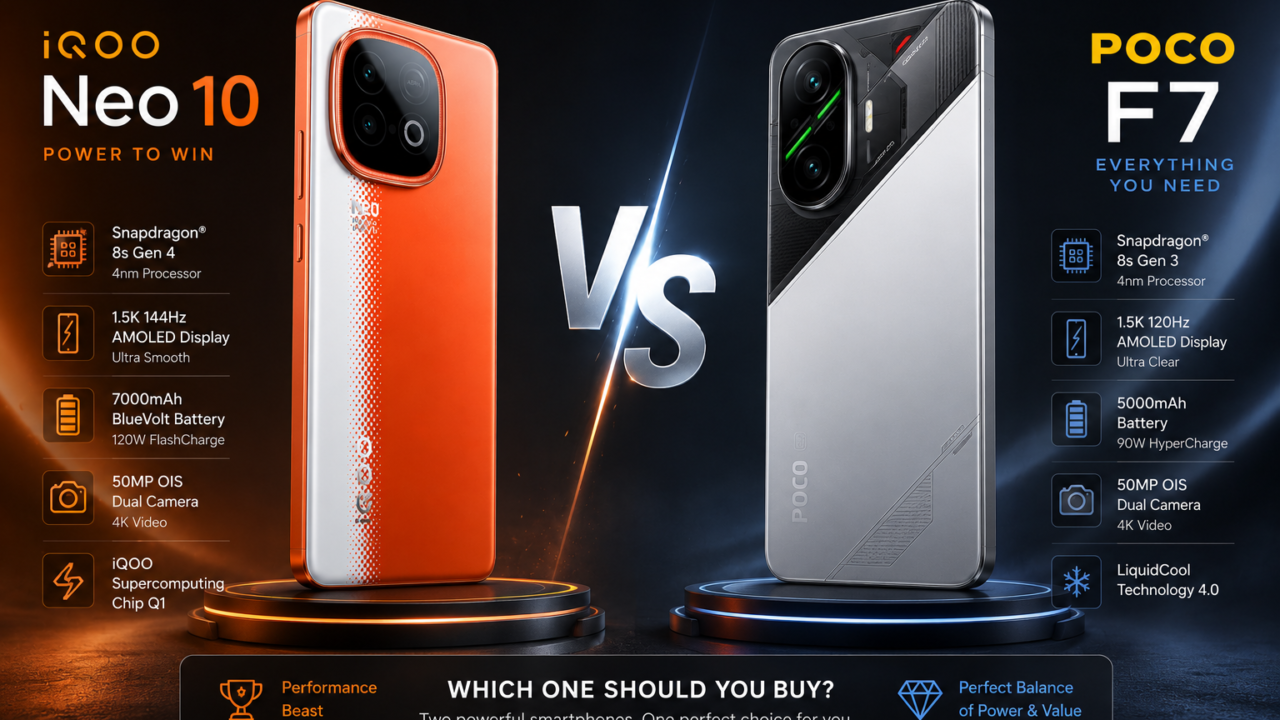
POCO F7 vs iQOO Neo 10 — two performance-focused smartphones that have taken the Indian market by storm in 2026. Both devices pack flagship-grade Snapdragon chipsets, massive batteries, and high-refresh-rate AMOLED displays, all priced aggressively under ₹35,000. But when it comes to raw value, which one deserves your money?
According to official specifications, the POCO F7 brings India’s largest smartphone battery at 7550mAh with 90W charging, while the iQOO Neo 10 counters with a blazing 144Hz AMOLED display and industry-leading 120W FlashCharge. This detailed comparison breaks down every key aspect to help you decide which performance phone is the smarter buy in 2026.
 |
 |
| 🛒 Buy POCO F7 | 🛒 Buy iQOO Neo 10 |
POCO F7 vs iQOO Neo 10 — Quick Specs Comparison
| Specification | POCO F7 | iQOO Neo 10 |
| Display | 6.83″ AMOLED, 1.5K (1280×2772), 120Hz, 3200 nits peak | 6.78″ AMOLED, 1.5K (1260×2800), 144Hz, 4400 nits peak ✓ |
| Processor | Qualcomm Snapdragon 8s Gen 4 (4nm) | Qualcomm Snapdragon 8s Gen 4 (4nm) |
| GPU | Adreno 825 | Adreno 825 |
| RAM & Storage | 12GB + 256GB/512GB (UFS 4.1) ✓ | 8GB/12GB/16GB + 128GB/256GB/512GB (UFS 4.1) |
| Rear Camera | 50MP (OIS) + 8MP UW, 4K@60fps | 50MP (OIS) + 8MP UW, 4K@60fps |
| Front Camera | 20MP, 1080p@60fps | 32MP, 4K@60fps ✓ |
| Battery | 7550 mAh (India) ✓ | 7000 mAh |
| Fast Charging | 90W Turbo Charging | 120W FlashCharge ✓ |
| Cooling | Standard vapor chamber | 7000mm² vapor chamber, Supercomputing Chip Q1 ✓ |
| Build & IP Rating | Glass front/back (Gorilla Glass 7i), aluminum frame, IP68/IP69 ✓ | Glass front, plastic back/frame, IP65, MIL-STD-810H |
| Weight | 215.7g | 206g ✓ |
| Software | HyperOS 2 (Android 15) ✓ | FuntouchOS 15 (Android 15) |
| Price (India) | ₹35,999 (12GB+256GB) | ₹31,999 (8GB+128GB) ✓ |
Design & Build Quality
|
|
|
The POCO F7 features a premium construction with Gorilla Glass 7i on both the front and back, paired with an aluminum middle frame. According to official specifications, the device measures 163.1 x 77.9 x 8.2 mm and weighs 215.7 grams. The standout feature is its IP68/IP69 dual certification, making it one of the few phones in this segment to offer full dust tightness and water resistance up to 1.5 meters for 30 minutes. The Cyber Silver Edition, Frost White, and Phantom Black color options give buyers plenty of aesthetic choices.
The iQOO Neo 10 takes a different approach with a glass front but plastic back and frame construction. Per official claims, it measures 163.7 x 75.9 x 8.1 mm and weighs 206 grams — slightly lighter and more compact than the POCO F7. The futuristic floating camera design and Inferno Red, Titanium Chrome, Blaze Orange, and Onyx Black colorways give it a bold, gamer-centric aesthetic. It carries an IP65 rating and MIL-STD-810H military-grade certification for toughness.
While the iQOO Neo 10 is lighter and offers military-grade toughness, the POCO F7’s dual-glass construction with aluminum frame and superior IP68/IP69 rating provide a more premium and water-resistant package. For buyers who prioritize premium materials and full waterproofing, POCO is the clear winner.
Advantage — Design: POCO F7
Display Comparison
Both phones feature stunning 1.5K AMOLED displays, but the iQOO Neo 10 pulls ahead in several key areas. According to the manufacturer, the iQOO Neo 10 sports a 6.78-inch AMOLED panel with a 144Hz refresh rate, 4320Hz PWM dimming for eye comfort, and an incredible 4400 nits peak brightness. The 453 ppi pixel density and 2000 nits HBM brightness ensure excellent visibility even under direct sunlight. The higher 144Hz refresh rate compared to POCO’s 120Hz delivers noticeably smoother scrolling and gaming.
The POCO F7 counters with a slightly larger 6.83-inch AMOLED display featuring 1.5K resolution (1280×2772), 120Hz refresh rate, and 3200 nits peak brightness. Based on published data, the panel supports Dolby Vision and HDR10+ for enhanced HDR content playback. The 447 ppi pixel density is nearly identical to the iQOO, and the display quality is excellent for the price segment. However, the lower refresh rate and brightness ceiling put it at a slight disadvantage against the iQOO Neo 10’s more advanced panel.
Advantage — Display: iQOO Neo 10
Performance — Snapdragon 8s Gen 4 vs Snapdragon 8s Gen 4
Both the POCO F7 and iQOO Neo 10 are powered by the identical Qualcomm Snapdragon 8s Gen 4 chipset built on a 4nm process. According to official specifications, this octa-core processor features one Cortex-X4 core at 3.21GHz, three Cortex-A720 cores at 3.0GHz, two Cortex-A720 cores at 2.8GHz, and two Cortex-A720 cores at 2.0GHz, all paired with the Adreno 825 GPU. On paper, both devices should deliver nearly identical raw performance.
However, benchmark scores reveal interesting differences. Based on published data, the POCO F7 achieves an AnTuTu v11 score of approximately 2,106,422, while the iQOO Neo 10 scores around 2,066,325. The POCO F7 also edges ahead in 3DMark Wild Life Extreme with 4,363 points versus the iQOO Neo 10’s 4,916. The iQOO Neo 10 compensates with a dedicated Supercomputing Chip Q1 for gaming optimization, a massive 7000mm² vapor chamber cooling system, and support for 144fps gaming with frame interpolation. The iQOO also offers up to 16GB RAM in its top variant, compared to POCO’s maximum 12GB.
For pure gaming enthusiasts, the iQOO Neo 10’s superior cooling, dedicated gaming chip, and higher RAM ceiling give it a practical edge despite nearly identical benchmark scores. For general users, both phones handle any task with ease.
Advantage — Performance: Tie (iQOO Neo 10 for gaming, POCO F7 for benchmarks)
Battery Life & Charging Speed
Battery life is where the POCO F7 absolutely dominates. According to official specifications, the Indian variant of the POCO F7 houses a massive 7550mAh silicon-carbon battery — the largest capacity on any smartphone currently available in India. The manufacturer claims exceptional endurance, and PC Mark battery tests suggest over 20 hours of continuous usage. The 90W Turbo Charging can juice the battery from 20% to 100% in approximately 45 minutes. Additionally, 22.5W reverse wired charging allows the POCO F7 to act as a power bank for other devices.
The iQOO Neo 10 features a 7000mAh silicon-carbon battery, which is impressive in its own right but falls 550mAh short of the POCO F7. Where the iQOO truly shines is charging speed — its 120W FlashCharge can charge the battery from 1% to 100% in just 36 minutes, with 50% charge achieved in merely 15 minutes. The iQOO also supports bypass charging for gaming sessions, 100W PPS and PD protocols, and reverse wired charging. For users who value charging speed over absolute capacity, the iQOO Neo 10 is the better pick.
Advantage — Battery: POCO F7 (for capacity and endurance)
Advantage — Charging: iQOO Neo 10 (for speed)
Final Verdict — Which Should You Buy?
|
🏆 Buy POCO F7 If
|
📋 Buy iQOO Neo 10 If
|
After comparing both devices on paper, the choice between the POCO F7 and iQOO Neo 10 comes down to your specific priorities. The POCO F7 wins for buyers who value endurance above all else — its 7550mAh battery, IP68/IP69 rating, and premium glass-aluminum construction make it the more durable and long-lasting option. The 12GB RAM base variant also delivers better out-of-the-box value compared to iQOO’s 8GB base model.
The iQOO Neo 10, however, is the superior choice for gaming enthusiasts and display purists. Its 144Hz AMOLED panel with 4400 nits brightness, 120W FlashCharge, dedicated Q1 gaming chip, and massive vapor chamber cooling system create a more immersive and responsive gaming experience. The lower starting price of ₹31,999 also makes it more accessible for budget-conscious buyers who don’t mind the 8GB RAM base variant.
|
POCO F7 8.6 / 10 Endurance Champion with Premium Build |
iQOO Neo 10 8.7 / 10 Gaming Powerhouse with Best Display |
| 🛒 Buy POCO F7 | 🛒 Buy iQOO Neo 10 |
📄 Also Read: Samsung Galaxy A27 5G vs OnePlus N6 — A detailed comparison of two budget 5G smartphones under ₹25,000 for Indian buyers in 2026.
Affiliate Disclosure: This post contains affiliate links. If you purchase through these links, we may earn a small commission at no extra cost to you.
Content Disclosure: This content was produced with AI assistance and human review to ensure accuracy, fairness, and helpfulness for our readers.