
- POCO X8 Pro 5G Review 2026: Price, Specs, Performance & Verdict
- Quick Verdict
- POCO X8 Pro 5G Key Specifications
- POCO X8 Pro 5G Design & Build Quality
- POCO X8 Pro 5G Display
- POCO X8 Pro 5G Performance
- POCO X8 Pro 5G Gaming Performance
- POCO X8 Pro 5G Camera
- Daylight Camera
- Portrait Camera
- Night Photography
- Ultrawide Camera
- Selfie Camera
- Video Recording
- POCO X8 Pro 5G Software & Features
- POCO X8 Pro 5G Battery Life & Charging
- POCO X8 Pro 5G Connectivity
- POCO X8 Pro 5G Full Specifications
- Pros & Cons
- Price & Availability in India
- Competitors & Alternatives
- Who Should Buy the POCO X8 Pro 5G?
- Who Should Skip the POCO X8 Pro 5G?
- Final Verdict — Is the POCO X8 Pro 5G Worth Buying?
- Frequently Asked Questions
Smartphones | Review | 2026
POCO X8 Pro 5G Review 2026: Price, Specs, Performance & Verdict
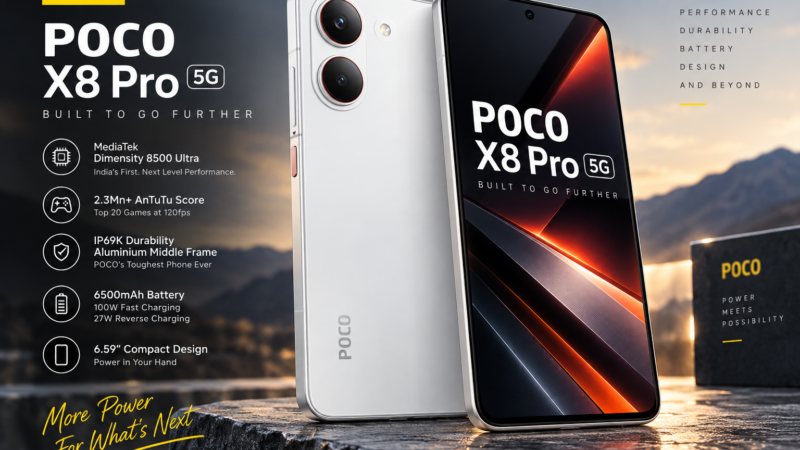
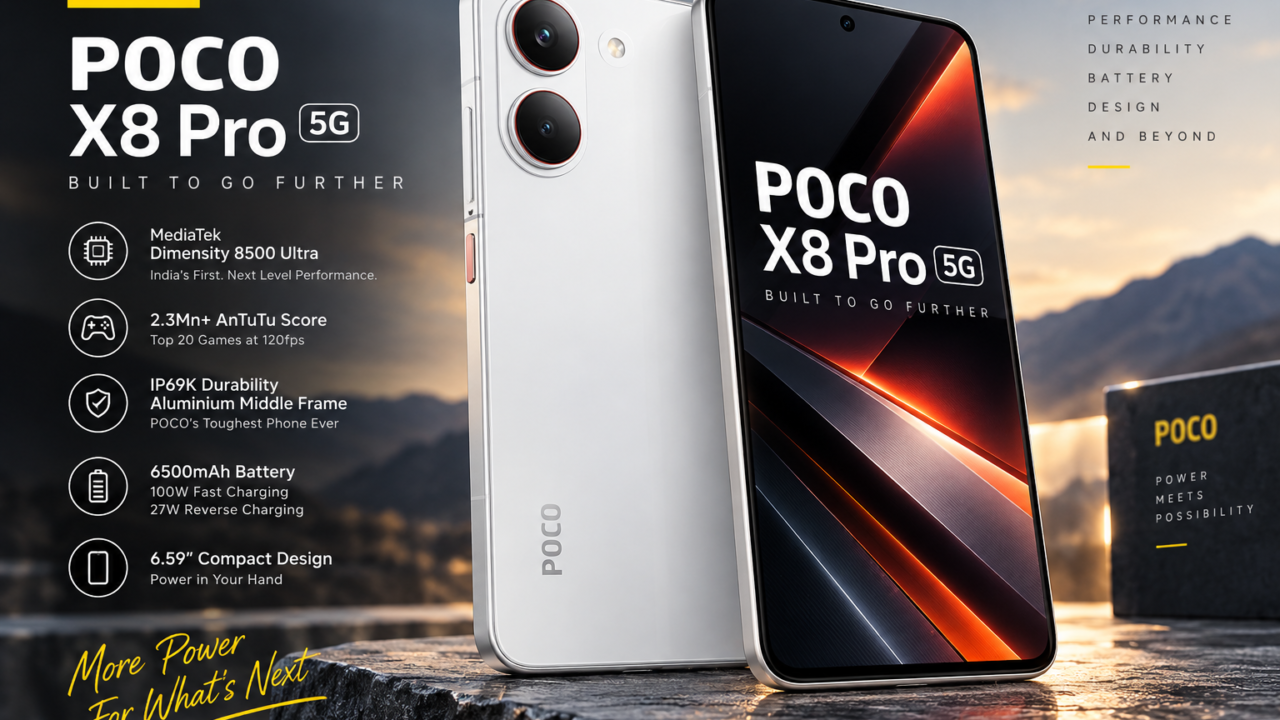
The POCO X8 Pro 5G has arrived in India as the brand’s latest attempt to own the “flagship killer” tag in the upper mid-range segment, and on paper, it makes a strong case with a MediaTek Dimensity 8500 Ultra chipset, a 6500mAh battery, and 100W fast charging packed into a compact 6.59-inch body. POCO has positioned this as its most powerful X-series phone yet, and based on official specifications, it appears to target buyers who care more about raw performance and sustained gaming than camera versatility.
This review breaks down every aspect of the POCO X8 Pro 5G based on official manufacturer specifications, from its IP69K-rated build and 120Hz AMOLED display to its camera setup, battery life, and where it fits against rivals like the Motorola Edge 70 Fusion and realme P3 Ultra. If you are deciding whether this phone is worth its price in India in 2026, this guide should help you get there.
Quick Verdict
The POCO X8 Pro 5G appears to be one of the strongest performance-per-rupee options in its segment, according to specifications, thanks to the Dimensity 8500 Ultra chipset and a claimed AnTuTu score of over 2.3 million. The 6500mAh battery with 100W wired and 27W reverse charging, along with an IP69K durability rating, further strengthen its case as a daily-use, gaming-first device.
However, the camera system remains a modest 50MP main plus 8MP ultrawide combination without a dedicated telephoto lens, which means buyers chasing versatile photography may want to look elsewhere. For buyers prioritizing chipset performance, battery longevity, and build toughness over camera flexibility, the POCO X8 Pro 5G looks like a well-rounded pick based on its specification sheet.

POCO X8 Pro 5G Key Specifications
Before diving into the detailed sections, here is a quick snapshot of what the POCO X8 Pro 5G brings to the table based on official specifications: a MediaTek Dimensity 8500 Ultra processor, a 6.59-inch 1.5K AMOLED display with 120Hz refresh rate, up to 12GB RAM with 256GB storage, a 50MP dual rear camera setup, and a 6500mAh battery supporting 100W wired fast charging.
Additional highlights include an IP69K durability rating, an aluminium middle frame, HyperOS 3 running on Android 16, and 5G connectivity with dual SIM support. The full specifications table further down this review lists every detail buyers may want to check before purchase.
POCO X8 Pro 5G Design & Build Quality
POCO has moved away from the plastic-heavy build of the X7 Pro and introduced a glass-and-metal sandwich design with an aluminium middle frame for the X8 Pro 5G. According to the manufacturer, this is the toughest phone POCO has built in the X-series so far, backed by an IP69K rating that covers resistance against dust, high-pressure water jets, and steam, not just splashes.
The design language leans minimal, with a dual-ring camera module on the back and a signature red accent on the power button that echoes POCO’s older design cues. At a claimed weight in the 200-gram range, it sits slightly heavier than ultra-slim rivals, but this appears to be a trade-off for the larger battery and reinforced chassis.
The phone is offered in Black, Green, and White colourways, with the White variant carrying a clean, premium finish based on official images. Port layout includes a USB-C charging port, a speaker grille, a secondary microphone up top, and a SIM tray on the frame, keeping the design fairly conventional for the segment.

POCO X8 Pro 5G Display
The POCO X8 Pro 5G features a 6.59-inch AMOLED panel with a 1.5K resolution and a 120Hz refresh rate, according to official specifications, positioning it well ahead of budget phones still running standard Full HD+ screens. The compact size compared to the many 6.7-inch-plus phones flooding this segment could appeal to buyers who prefer a device that is easier to use one-handed.
The panel is protected by Corning Gorilla Glass 7i, an upgrade over Gorilla Glass Victus-class protection on some rivals in terms of everyday scratch resistance, though not the toughest tier available. Brightness figures have not been officially detailed in full, but based on the segment and the AMOLED panel type, outdoor visibility should be reasonably strong.
For media consumption and gaming, the 120Hz refresh rate paired with the Dimensity 8500 Ultra should translate to smooth scrolling and animations, on paper. The punch-hole selfie camera cutout is centered at the top of the display, keeping the design consistent with most 2026-era AMOLED smartphones.
POCO X8 Pro 5G Performance
At the heart of the POCO X8 Pro 5G is the MediaTek Dimensity 8500 Ultra, a chipset the company claims delivers a Geekbench-class performance jump over the previous generation Dimensity 8400 used in the X7 Pro. POCO states the phone can hit an AnTuTu score of over 2.3 million points, a number that, if accurate, would place it comfortably ahead of most competitors in this price bracket.
The chipset is paired with up to 12GB of RAM and UFS-class storage in 256GB and higher configurations, which should help with day-to-day multitasking, app switching, and running demanding applications without noticeable slowdown, based on the hardware configuration.
HyperOS 3, running on top of Android 16, is expected to handle background app management and RAM optimization, though real-world software behaviour can vary with future updates. Buyers upgrading from older MediaTek or Snapdragon 7-series chipsets should notice a meaningful improvement in day-to-day responsiveness, according to the specification sheet.
POCO X8 Pro 5G Gaming Performance
POCO markets the X8 Pro 5G as capable of running the “top 20 games” at 120fps, a claim tied directly to the Dimensity 8500 Ultra’s graphics performance and the phone’s 120Hz display. For titles like BGMI, Call of Duty Mobile, and Genshin Impact, this suggests headroom for high frame-rate settings, though actual sustained frame rates will depend on individual game optimization.
An X-axis linear motor is included for haptic feedback during gaming, which on paper should make in-game vibrations feel sharper and more directional compared to the rotary motors found in many budget and mid-range phones.
Sustained gaming performance will also depend on thermal management, which POCO has not detailed with specific vapour chamber size figures in its official material for this exact variant. Buyers who game for extended sessions should keep an eye on independent thermal throttling benchmarks once they become available.
POCO X8 Pro 5G Camera
The camera setup on the POCO X8 Pro 5G is fairly straightforward: a 50MP primary sensor paired with an 8MP ultrawide lens on the back, and a 20MP sensor housed in the front punch-hole. Unlike some competitors in this price range, POCO has not included a dedicated telephoto or macro lens, which keeps the camera module simpler but also more limited in versatility.
Cameras have historically not been the highlight of POCO’s X-series lineup, and based on the spec sheet alone, the X8 Pro appears to continue that trend by prioritizing performance and battery life over imaging hardware.
Daylight Camera
In good lighting, the 50MP main sensor should be capable of producing detailed, well-exposed shots, which is typically the strongest scenario for phones in this segment. Since the resolution matches sensors used across many competing devices, daylight output is expected to be competitive rather than class-leading.
Portrait Camera
With no dedicated depth or telephoto sensor, portrait shots will likely rely on software-based bokeh processing from the main camera. This is common in this price bracket, but edge detection and background blur quality can vary noticeably compared to phones that include a hardware depth sensor.
Night Photography
Low-light performance will depend heavily on the sensor size and the night mode algorithm in HyperOS 3, neither of which POCO has detailed extensively in its official specification sheet. Buyers who frequently shoot in dim conditions should treat this as an area to verify through independent camera samples before purchase.
Ultrawide Camera
The 8MP ultrawide lens is on the lower end for 2026-era phones, where 13MP-and-above ultrawide sensors are becoming more common even in the mid-range. This means wide-angle shots may show a visible drop in detail and dynamic range compared to the primary sensor.
Selfie Camera
The 20MP front camera should be sufficient for everyday selfies and video calls, based on the specification sheet, and matches the resolution commonly used across this price segment. No secondary front sensor or autofocus has been mentioned officially, keeping the setup fairly basic.
Video Recording
Detailed video recording specifications, including maximum resolution and frame rate support along with stabilization features, have not been fully disclosed by POCO for this exact configuration at the time of writing. Buyers who prioritize video capture should check for updated specification sheets or hands-on coverage closer to their purchase date.
POCO X8 Pro 5G Software & Features
The POCO X8 Pro 5G ships with HyperOS 3, Xiaomi’s custom skin, layered on top of Android 16. HyperOS has steadily matured across its iterations, and by version 3, it is expected to bring improved cross-device connectivity, refined animations, and continued AI-assisted features for photography and system optimization, according to the manufacturer.
POCO has historically offered a reasonable software update commitment on its X-series devices, though official confirmation of the exact number of years of Android version upgrades and security patches for this specific model was not detailed in the material reviewed for this piece. Buyers concerned about long-term software support should verify this directly with POCO India or the retailer at the time of purchase.
POCO X8 Pro 5G Battery Life & Charging
The 6500mAh battery is one of the standout specifications on the POCO X8 Pro 5G, comfortably ahead of many phones in this price range that still ship with 5000mAh cells. Paired with the efficiency gains expected from the Dimensity 8500 Ultra’s fabrication process, this battery size suggests strong all-day usage potential for typical users, based on the hardware configuration.
Charging is handled through a 100W wired fast-charging solution, which POCO claims can take the phone from a low charge to a substantial percentage in well under half an hour. A 27W reverse wired charging feature is also included, allowing the phone to top up other devices or accessories when needed.
Whether the in-box charger matches the phone’s full 100W charging capability, or whether buyers will need to purchase a compatible charger separately, has not been explicitly confirmed in the specifications reviewed, so this is worth checking on the retail listing before purchase.
POCO X8 Pro 5G Connectivity
The POCO X8 Pro 5G supports 5G connectivity along with dual SIM functionality, ensuring compatibility with all major Indian telecom networks and their 5G rollouts. Wi-Fi and Bluetooth support are expected to meet current-generation standards, though exact Wi-Fi and Bluetooth version numbers have not been detailed extensively in the available specification sheet.
A USB-C port handles charging and data transfer, and the phone includes stereo speakers based on the dual speaker grille visible in official design renders, which should improve media playback and gaming audio compared to single-speaker devices at similar price points.
POCO X8 Pro 5G Full Specifications
| Specification | Details |
| Processor | MediaTek Dimensity 8500 Ultra |
| Display | 6.59″ 1.5K AMOLED, 120Hz refresh rate, Gorilla Glass 7i |
| RAM / Storage | 8GB / 256GB (also available up to 12GB / 256GB) |
| Rear Camera | 50MP main + 8MP ultrawide |
| Front Camera | 20MP |
| Battery | 6500mAh |
| Charging | 100W wired fast charging + 27W reverse wired charging |
| Build | IP69K durability rating, aluminium middle frame, X-axis linear motor |
| Operating System | HyperOS 3, based on Android 16 |
| Connectivity | 5G, Dual SIM, USB-C, stereo speakers |
| Colours | Black, Green, White |
| India Price | Starts around ₹32,999 at launch (8GB/256GB); current retail pricing may vary |
Pros & Cons
|
✅ Pros
|
❌ Cons
|
Price & Availability in India
The POCO X8 Pro 5G launched in India at a starting price of around ₹32,999 for the 8GB/256GB variant, with a 12GB/256GB configuration priced higher, according to official launch pricing. As with most POCO devices, retail pricing can fluctuate over time due to demand, festive sales, and bank offers, so the price at the point of purchase may differ from the launch figure.
The phone is available through Flipkart and the official POCO India online store, and buyers should compare current listings across platforms, including Amazon India, for the best available deal, exchange offers, and bank discounts before purchasing.
Competitors & Alternatives
Within the sub-₹40,000 segment, the POCO X8 Pro 5G competes closely with the Motorola Edge 70 Fusion and Motorola Edge 70, both of which lean more toward camera performance and slim design rather than raw chipset power. Buyers wanting a more balanced camera experience alongside solid performance may find the Edge 70 Fusion a worthwhile comparison point.
The realme P3 Ultra and OPPO K13 Turbo 5G are two more direct rivals, with the K13 Turbo also targeting sustained gaming performance through its own cooling-focused design. Outside this immediate list, the Xiaomi Redmi Turbo 5 and OnePlus Nord 6 are also worth cross-checking, since both offer larger batteries and, in some cases, higher front camera resolution, according to comparison data.
📄 Also Read: POCO F7 5G Review — Wondering how POCO’s other 2026 performance pick stacks up against the X8 Pro? Here’s the full breakdown.
📄 Also Read: Top 10 Laptops for Engineering Students in 2026 — Sorting out your phone is only half the setup; here’s our complete laptop buying guide for the year.
Who Should Buy the POCO X8 Pro 5G?
Buyers who prioritize benchmark-topping performance, competitive gaming, and long-lasting battery life over camera versatility appear to be the ideal audience for the POCO X8 Pro 5G, based on its specification sheet. The IP69K rating also makes it a reasonable pick for anyone who wants extra peace of mind around accidental water exposure or dusty environments.
Students and professionals who rely on their phone for extended screen-on time, frequent gaming sessions, and quick top-up charging between classes or meetings should find the combination of the Dimensity 8500 Ultra and 100W charging appealing on paper.
If your usage largely revolves around social media, casual browsing, and everyday photography rather than heavy gaming, some of the alternatives mentioned above may offer a better balance for a similar or lower price.
Who Should Skip the POCO X8 Pro 5G?
Photography-focused buyers who want a telephoto lens, a higher-resolution ultrawide sensor, or class-leading low-light performance should probably look at the Motorola Edge 70 Fusion or similarly camera-forward phones in this price range instead.
Buyers on a tighter budget who don’t need flagship-level gaming performance may also find better value in lower-priced POCO or Redmi models, since a large part of the X8 Pro’s price premium appears tied to its chipset and battery upgrades rather than an all-round experience.
Final Verdict — Is the POCO X8 Pro 5G Worth Buying?
Based on official specifications, the POCO X8 Pro 5G looks like a compelling performance-and-battery-focused smartphone for 2026, backed by the Dimensity 8500 Ultra chipset, a 6500mAh cell, 100W charging, and genuine durability credentials through its IP69K rating. For buyers who put chipset performance and gaming ahead of camera versatility, it appears to justify its position in the sub-₹40,000 segment.
The trade-off is a fairly basic camera system that lacks a telephoto lens and uses a modest ultrawide sensor, which means it isn’t the strongest all-rounder on this list. Buyers should weigh their own priorities — performance and battery versus photography — before deciding between the X8 Pro and its closest rivals.
Our Rating
8.1 / 10
Strong performer for gamers, modest for photographers
🛒 Buy POCO X8 Pro 5G on Amazon
Also check official specs at POCO India Official Website
Frequently Asked Questions
Q: Does the POCO X8 Pro 5G support 5G on all Indian networks?
A: Yes, based on official specifications, the phone supports 5G connectivity along with dual SIM functionality, making it compatible with major Indian telecom operators.
Q: Is the POCO X8 Pro 5G good for gaming?
A: On paper, yes. The MediaTek Dimensity 8500 Ultra chipset combined with the 120Hz display and X-axis linear motor suggests strong gaming performance, according to the manufacturer’s claims.
Q: Does the POCO X8 Pro 5G have a telephoto camera?
A: No, based on official specifications, the rear camera setup includes only a 50MP main sensor and an 8MP ultrawide lens, with no dedicated telephoto lens.
Q: What is the battery and charging speed of the POCO X8 Pro 5G?
A: The phone packs a 6500mAh battery with 100W wired fast charging support and 27W reverse wired charging, according to the manufacturer.
Q: Is the POCO X8 Pro 5G water resistant?
A: Yes, it carries an IP69K durability rating according to official specifications, offering resistance against dust, high-pressure water jets, and steam exposure.
Affiliate Disclosure: This post contains affiliate links. If you purchase through these links, we may earn a small commission at no extra cost to you.
Content Disclosure: This content was produced with AI assistance and human review to ensure accuracy, fairness, and helpfulness for our readers.