
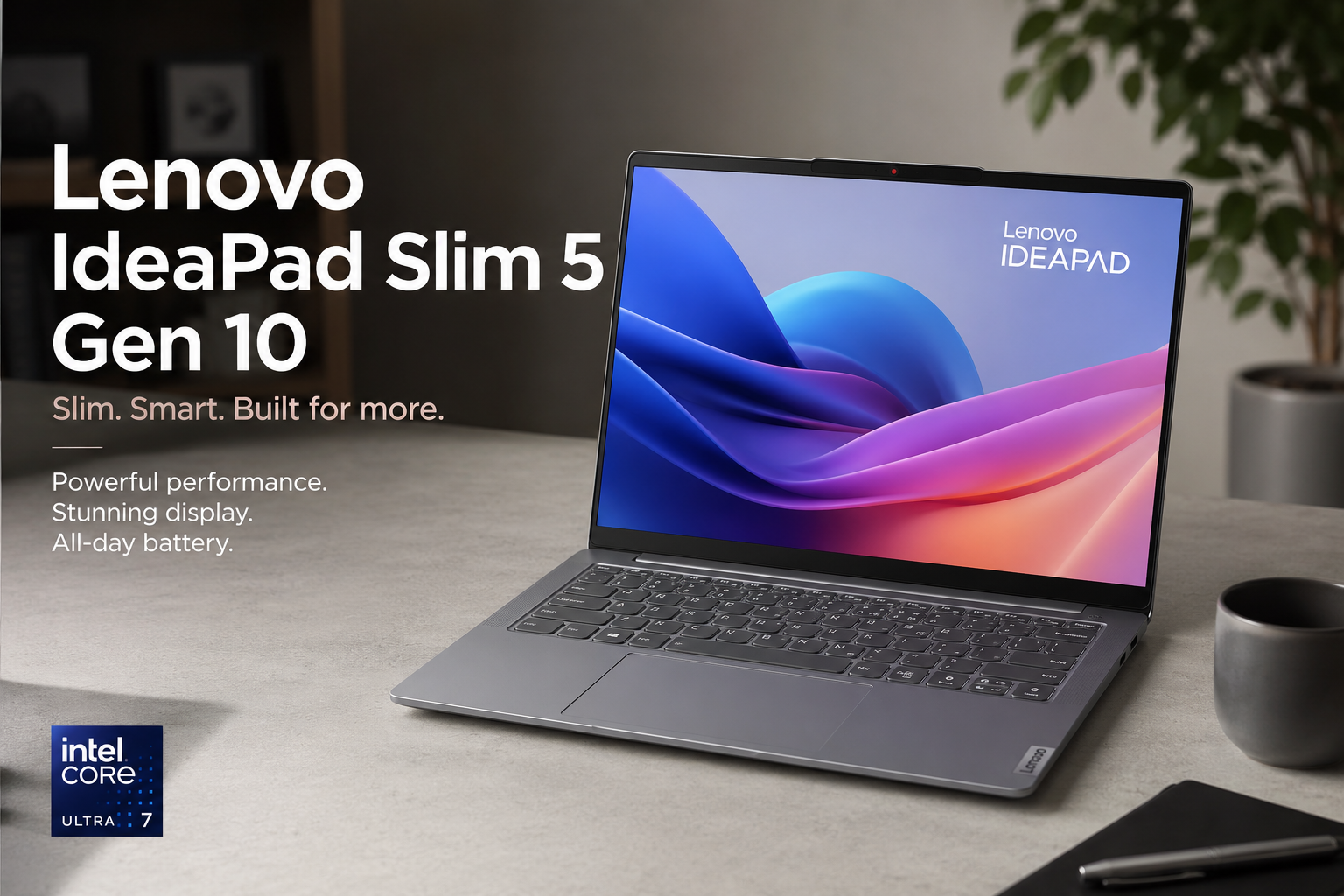
- Lenovo IdeaPad Slim 5 Gen 10 vs MSI Prestige 14 AI Evo (2026) — Which Ultraportable Wins?
- Lenovo IdeaPad Slim 5 Gen 10 vs MSI Prestige 14 AI Evo — Quick Specs Comparison
- Design & Build Quality
- Display Comparison
- Performance — AMD Ryzen 7 7735HS vs Intel Core Ultra 7 155H
- Battery Life & Connectivity
- Final Verdict — Which Should You Buy?
PREMIUM ULTRAPORTABLE LAPTOPS | Comparison | 2026
Lenovo IdeaPad Slim 5 Gen 10 vs MSI Prestige 14 AI Evo (2026) — Which Ultraportable Wins?
Lenovo IdeaPad Slim 5 Gen 10 vs MSI Prestige 14 AI Evo — two of the most compelling ultraportable laptops in the Indian market for 2026, both targeting professionals, students, and content creators who refuse to compromise on portability or performance. The Lenovo IdeaPad Slim 5 Gen 10 brings AMD Ryzen 7 7735HS power in a remarkably lightweight 1.15 kg aluminum chassis, while the MSI Prestige 14 AI Evo counters with Intel Core Ultra 7 155H efficiency, a massive 90Wh battery, and cutting-edge Wi-Fi 7 connectivity.
This comparison matters because both laptops occupy the premium ultraportable segment priced between ₹65,000 and ₹90,000 in India. Choosing between them depends on whether you prioritize extreme portability and display brightness (Lenovo) or battery endurance, upgradeability, and future-proof connectivity (MSI). According to official specifications, both machines are MIL-STD-810H certified, feature 100% sRGB displays, and include Windows 11 Home with AI-enhanced features — yet they differ significantly in design philosophy, performance tuning, and real-world usability.
 |
 |
| 🛒 Buy Lenovo IdeaPad Slim 5 | 🛒 Buy MSI Prestige 14 AI Evo |
Lenovo IdeaPad Slim 5 Gen 10 vs MSI Prestige 14 AI Evo — Quick Specs Comparison
| Specification | Lenovo IdeaPad Slim 5 Gen 10 | MSI Prestige 14 AI Evo |
| Processor | AMD Ryzen 7 7735HS (8C/16T, up to 4.75GHz) | Intel Core Ultra 7 155H (16C/22T, up to 4.8GHz) ✓ |
| Display | 13.3″ WUXGA (1920×1200), 400 nits, 100% sRGB ✓ | 14″ FHD+ (1920×1200), 144Hz, 100% sRGB |
| RAM | 16GB LPDDR5X-6400 (Soldered) | 16GB DDR5-5600 (2 SO-DIMM slots, up to 64GB) ✓ |
| Storage | 512GB NVMe PCIe 4.0 SSD (1 slot) | 1TB NVMe PCIe 4.0 SSD (2 M.2 slots) ✓ |
| Graphics | AMD Radeon 680M (RDNA 2, 12 CUs) ✓ | Intel Arc Graphics (8 Xe Cores) |
| Weight | 1.15 kg ✓ | 1.7 kg |
| Thickness | 14.3 mm ✓ | 18.95 mm |
| Battery | 54.7Wh (up to 19.9 hrs video) | 90Wh (up to 13+ hrs real-world) ✓ |
| Wi-Fi | Wi-Fi 6E (802.11ax) | Wi-Fi 7 (802.11be) ✓ |
| Thunderbolt | No (USB-C 3.2 Gen 2 only) | 2× Thunderbolt 4 ✓ |
| Build | All-metal, MIL-STD-810H ✓ | Aluminum, MIL-STD-810H |
| Security | FHD IR Camera, Privacy Shutter | Fingerprint + IR + Webcam Shutter + dTPM 2.0 ✓ |
| Price (India) | ~₹62,250 ✓ | ~₹85,000–₹90,000 |
Design & Build Quality
 |
 |
The Lenovo IdeaPad Slim 5 Gen 10 is a masterclass in ultraportable engineering. According to official specifications, the chassis measures just 14.3 mm thick and weighs an astonishing 1.15 kg — making it one of the lightest 13.3-inch laptops with an 8-core processor available in India in 2026. The all-metal aluminum unibody construction meets MIL-STD-810H military standards across 21 test categories, ensuring durability against temperature extremes, humidity, vibration, and shock. The manufacturer claims three color options: Cloud Grey, Glacier White, and Polar Blue, giving users a degree of personalization rare in this segment.
The MSI Prestige 14 AI Evo takes a different approach, prioritizing functionality and battery capacity over absolute minimalism. Per official claims, the Stellar Gray aluminum chassis measures 18.95 mm thick and weighs 1.7 kg — noticeably heavier than the Lenovo, though still comfortably portable for daily commuting. The 180-degree hinge is a thoughtful addition for business presentations, and the chassis also carries MIL-STD-810H certification. However, the MSI offers superior security with a fingerprint scanner integrated into the power button, discrete TPM 2.0, and Tobii Aware software for privacy protection — features absent on the Lenovo.
Advantage — Design: The Lenovo IdeaPad Slim 5 Gen 10 wins for pure portability and aesthetic variety, though the MSI Prestige 14 AI Evo offers superior security features and a more practical hinge design for business users. For travelers and students prioritizing minimal weight, the Lenovo is the clear choice. For professionals needing enterprise-grade security, the MSI takes the lead.
Display Comparison
Both laptops feature 16:10 aspect ratio displays with 1920×1200 resolution, but the execution differs significantly. The Lenovo IdeaPad Slim 5 Gen 10 packs a 13.3-inch WUXGA IPS panel rated at 400 nits brightness with 100% sRGB coverage, anti-glare coating, and TÜV Rheinland Low Blue Light certification. On paper, the 400-nit brightness is exceptional for an ultraportable — most competitors in this segment offer 250–300 nits. The 90% screen-to-body ratio with slim bezels creates an immersive viewing experience, and the Eyesafe 2.0 certification ensures reduced eye strain during extended work sessions.
The MSI Prestige 14 AI Evo counters with a larger 14-inch FHD+ IPS display that adds a 144Hz refresh rate — a rarity in business ultraportables. While the manufacturer does not specify peak brightness in official documentation, the panel maintains 100% sRGB coverage and includes an ambient light sensor for automatic brightness adjustment. The 144Hz refresh rate delivers noticeably smoother scrolling and cursor movement, though the practical benefit for productivity work is marginal. The larger 14-inch screen provides approximately 11% more screen real estate than the Lenovo’s 13.3-inch panel, which benefits spreadsheet work and split-screen multitasking.
Advantage — Display: The Lenovo IdeaPad Slim 5 Gen 10 wins for outdoor visibility and color accuracy at 400 nits, while the MSI Prestige 14 AI Evo takes the lead for refresh rate smoothness and screen size. For content creators working in varied lighting conditions, the Lenovo’s superior brightness is decisive. For office workers who value smooth UI interactions, the MSI’s 144Hz panel is compelling.
Performance — AMD Ryzen 7 7735HS vs Intel Core Ultra 7 155H
Based on the hardware configuration, the processor comparison reveals two distinct philosophies. The Lenovo IdeaPad Slim 5 Gen 10 is powered by the AMD Ryzen 7 7735HS, an 8-core, 16-thread processor built on Zen 3+ architecture with a 6nm process. According to official specifications, it runs at 3.2 GHz base clock with boost frequencies up to 4.75 GHz, paired with 20MB total cache (4MB L2 + 16MB L3). The integrated AMD Radeon 680M graphics feature RDNA 2 architecture with 12 compute units running at up to 2200 MHz — on paper, this represents the strongest integrated GPU solution in AMD’s lineup for thin-and-light laptops. The 16GB LPDDR5X-6400 memory is soldered and non-upgradeable, which limits future-proofing.
The MSI Prestige 14 AI Evo deploys the Intel Core Ultra 7 155H, a 16-core hybrid processor (6 P-cores + 8 E-cores + 2 Low Power E-cores) with 22 threads and 24MB Intel Smart Cache. Per official claims, the chip reaches up to 4.8 GHz turbo frequency and includes Intel AI Boost (NPU) for on-device AI acceleration — a feature increasingly relevant in 2026 as Windows Copilot and AI-enhanced applications mature. The integrated Intel Arc graphics with 8 Xe cores deliver competitive performance, though the AMD Radeon 680M holds a slight edge in raw GPU compute. Crucially, the MSI offers 2 SO-DIMM slots supporting up to 64GB DDR5-5600 RAM and dual M.2 SSD slots, providing exceptional upgradeability rare in ultraportables.
Based on published data, the Intel Core Ultra 7 155H generally outperforms the Ryzen 7 7735HS in multi-threaded workloads due to its higher core count, while the AMD chip maintains efficiency advantages in single-threaded tasks and integrated graphics performance. The MSI’s dual-fan cooling system also provides better sustained performance under load compared to the Lenovo’s single-fan configuration, which may experience thermal throttling during extended intensive operations.
Advantage — Performance: The MSI Prestige 14 AI Evo wins for raw multi-core performance, AI acceleration, and upgradeability. The Lenovo IdeaPad Slim 5 Gen 10 holds advantages in integrated graphics performance and power efficiency. For programmers, data analysts, and AI enthusiasts, the MSI is the superior choice. For light gaming and content creation, the Lenovo’s Radeon 680M provides better value.
Battery Life & Connectivity
Battery life represents the most dramatic difference between these two machines. The MSI Prestige 14 AI Evo houses a massive 90Wh battery — one of the largest in any 14-inch ultraportable. According to the manufacturer, this delivers up to 13+ hours of real-world productivity use, and independent testing confirms over 13 hours in video playback benchmarks. The 100W USB-C charger supports fast charging, reaching 52% capacity in 30 minutes. The inclusion of Wi-Fi 7 (Intel Killer BE1750) and Bluetooth 5.4 ensures cutting-edge wireless connectivity with theoretical speeds up to 5.8 Gbps — 2.4× faster than Wi-Fi 6E. The port selection is equally impressive: 2× Thunderbolt 4, 1× USB-A 3.2 Gen 2, HDMI 2.1 (8K@60Hz), Gigabit Ethernet, and a 3.5mm audio jack.
The Lenovo IdeaPad Slim 5 Gen 10 carries a more modest 54.7Wh battery, which the manufacturer claims can deliver up to 19.9 hours of local video playback. In real-world productivity scenarios, users can expect 10–12 hours of mixed-use battery life — respectable for a 1.15 kg machine, but clearly outclassed by the MSI’s endurance. The 65W USB-C charger supports Rapid Charge Boost, providing 2 hours of runtime from a 15-minute charge. Connectivity includes Wi-Fi 6E, Bluetooth 5.3, 2× USB-C 3.2 Gen 2 (10Gbps with PD and DP 1.4), 2× USB-A 3.2 Gen 1, HDMI 2.1, and a microSD card reader. Notably, the Lenovo lacks Thunderbolt support, which limits high-speed external GPU and docking station compatibility.
Advantage — Battery: The MSI Prestige 14 AI Evo is the decisive winner with its 90Wh battery delivering nearly double the real-world endurance of the Lenovo. Advantage — Connectivity: The MSI also wins with Wi-Fi 7, Thunderbolt 4, and Gigabit Ethernet — features that future-proof the machine for 2026 and beyond. The Lenovo’s only connectivity advantage is the inclusion of a microSD card reader, which benefits photographers and content creators.
Final Verdict — Which Should You Buy?
|
🏆 Buy Lenovo IdeaPad Slim 5 Gen 10 If
|
📋 Buy MSI Prestige 14 AI Evo If
|
For the majority of Indian buyers in 2026, the choice boils down to priorities. The Lenovo IdeaPad Slim 5 Gen 10 is the ideal companion for students, frequent travelers, and content creators who need a featherlight machine with a stunning display and capable integrated graphics. At approximately ₹62,250, it offers exceptional value with Microsoft Office 2024 bundled, making it a complete productivity package out of the box. However, the soldered RAM and smaller battery are compromises that power users will feel within two years.
The MSI Prestige 14 AI Evo, priced between ₹85,000 and ₹90,000, is a true business-class investment. The upgradeable memory, dual SSD slots, massive 90Wh battery, and cutting-edge Wi-Fi 7 ensure this laptop remains relevant through 2028 and beyond. The Intel NPU acceleration, while still emerging in 2026, positions the MSI advantageously as AI-enhanced applications become mainstream. For professionals, programmers, and anyone who treats their laptop as a primary workstation, the MSI justifies its premium with tangible long-term value.
|
Lenovo IdeaPad Slim 5 Gen 10 8.4 / 10 Best Ultraportable Value |
MSI Prestige 14 AI Evo 8.9 / 10 Best Business All-Rounder |
| 🛒 Buy Lenovo IdeaPad Slim 5 | 🛒 Buy MSI Prestige 14 AI Evo |
📄 Also Read: HP Victus 16 vs Lenovo Legion 5i Gen 10 Comparison — Gaming laptop showdown for Indian buyers.
📄 Also Read: Top 10 Laptops for Engineering Students in 2026 — Complete buying guide with detailed reviews.
Affiliate Disclosure: This post contains affiliate links. If you purchase through these links, we may earn a small commission at no extra cost to you.
Content Disclosure: This content was produced with AI assistance and human review to ensure accuracy, fairness, and helpfulness for our readers.