
- Lenovo IdeaPad Slim 5 Gen 10 vs MacBook Pro 14 M3 Pro (2026) — Which Laptop Should You Buy?
- Lenovo IdeaPad Slim 5 Gen 10 vs MacBook Pro 14 M3 Pro — Quick Specs Comparison
- Design & Build Quality
- Display Comparison
- Performance — AMD Ryzen 7 7735HS vs Apple M3 Pro
- Battery Life, Audio & Connectivity
- Final Verdict — Which Should You Buy?
PREMIUM LAPTOPS | Comparison | 2026
Lenovo IdeaPad Slim 5 Gen 10 vs MacBook Pro 14 M3 Pro (2026) — Which Laptop Should You Buy?
Lenovo IdeaPad Slim 5 Gen 10 vs MacBook Pro 14 M3 Pro — two laptops that occupy entirely different universes of the portable computing landscape in 2026, yet both command serious attention from Indian buyers seeking premium machines. The Lenovo IdeaPad Slim 5 Gen 10 is a Windows-based ultraportable champion, packing AMD Ryzen 7 7735HS power in a remarkably lightweight 1.15 kg aluminum chassis at around ₹62,000. The MacBook Pro 14 M3 Pro, on the other hand, is Apple’s professional-grade powerhouse built around the 3nm M3 Pro chip with up to 18-core GPU, Liquid Retina XDR display, and a price tag that starts near ₹1,90,000 in India.
This comparison matters because it represents the ultimate cross-platform dilemma facing Indian professionals, content creators, and students in 2026 — Windows versatility versus macOS optimization, budget-conscious value versus no-compromise performance, and ecosystem flexibility versus Apple’s walled garden. According to official specifications, both machines feature all-metal builds, high-resolution displays, and all-day battery claims, but they diverge dramatically in processing philosophy, software ecosystem, upgradeability, and real-world value proposition for the Indian market.
 |
 |
| 🛒 Buy Lenovo IdeaPad Slim 5 | 🛒 Buy MacBook Pro 14 M3 Pro |
Lenovo IdeaPad Slim 5 Gen 10 vs MacBook Pro 14 M3 Pro — Quick Specs Comparison
| Specification | Lenovo IdeaPad Slim 5 Gen 10 | MacBook Pro 14 M3 Pro |
| Processor | AMD Ryzen 7 7735HS (8C/16T, up to 4.75GHz) | Apple M3 Pro (12C/18GPU, up to 4.05GHz) ✓ |
| Display | 13.3″ WUXGA (1920×1200), 400 nits, 100% sRGB | 14.2″ Liquid Retina XDR (3024×1964), 1600 nits peak, 120Hz ProMotion ✓ |
| RAM | 16GB LPDDR5X-6400 (Soldered) | 18GB Unified Memory (150GB/s bandwidth) ✓ |
| Storage | 512GB NVMe PCIe 4.0 SSD | 1TB SSD (Configurable to 4TB) ✓ |
| Graphics | AMD Radeon 680M (RDNA 2, 12 CUs) | 18-core Apple GPU (Hardware Ray Tracing) ✓ |
| Weight | 1.15 kg ✓ | 1.61 kg |
| Thickness | 14.3 mm ✓ | 15.5 mm |
| Battery | 54.7Wh (up to 19.9 hrs video) | 72.4Wh (up to 18 hrs video, 12+ hrs web) ✓ |
| Wi-Fi | Wi-Fi 6E (802.11ax) | Wi-Fi 6E (802.11ax) |
| Thunderbolt | No (USB-C 3.2 Gen 2 only) | 3× Thunderbolt 4 ✓ |
| Build | All-metal, MIL-STD-810H | 100% Recycled Aluminum, Premium Unibody ✓ |
| Security | FHD IR Camera, Privacy Shutter | Touch ID, Secure Enclave, T2 Security ✓ |
| OS | Windows 11 Pro (Office 2024 bundled) ✓ | macOS Sonoma |
| Price (India) | ~₹62,250 ✓ | ~₹1,90,000+ |
Design & Build Quality
 |
 |
The Lenovo IdeaPad Slim 5 Gen 10 is a masterclass in ultraportable engineering for the Windows ecosystem. According to official specifications, the chassis measures just 14.3 mm thick and weighs an astonishing 1.15 kg — making it one of the lightest 13.3-inch laptops with an 8-core processor available in India in 2026. The all-metal aluminum unibody construction meets MIL-STD-810H military standards across 21 test categories, ensuring durability against temperature extremes, humidity, vibration, and shock. The manufacturer claims three color options: Cloud Grey, Glacier White, and Polar Blue, giving users a degree of personalization rare in this segment. The 90% screen-to-body ratio with minimal bezels creates a modern, immersive aesthetic that punches well above its price point.
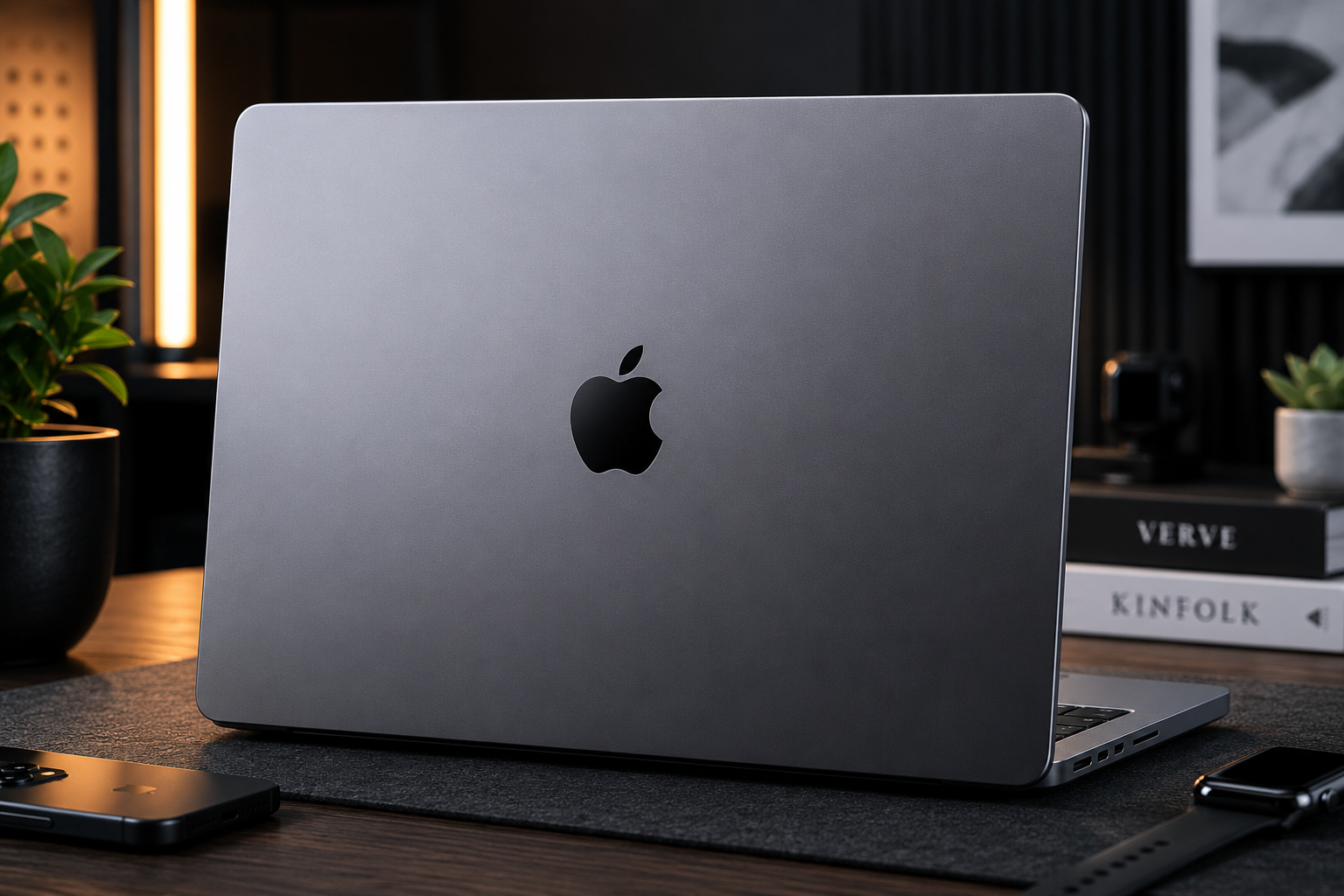
The MacBook Pro 14 M3 Pro represents the pinnacle of Apple’s industrial design philosophy. Per official claims, the 100% recycled aluminum unibody chassis measures 15.5 mm thick and weighs 1.61 kg — noticeably heavier than the Lenovo, though still portable for a 14-inch professional workstation. The Space Black and Silver finishes exude understated luxury, and the build quality is universally regarded as among the best in the industry. The manufacturer claims the enclosure uses 100% recycled aluminum, 100% recycled gold in plating, and 100% recycled rare earth elements in magnets — a sustainability commitment that resonates with environmentally conscious buyers in 2026. The six-speaker sound system with force-canceling woofers and studio-quality three-mic array are integrated seamlessly into the chassis, with no visible speaker grilles.
Advantage — Design: The MacBook Pro 14 M3 Pro wins for premium build quality, sustainability credentials, and integrated audio excellence. The Lenovo IdeaPad Slim 5 Gen 10 takes the lead for absolute portability and color variety. For travelers and students prioritizing minimal weight, the Lenovo is the clear choice. For professionals who value craftsmanship and acoustic performance, the MacBook is unmatched.
Display Comparison
The display comparison reveals one of the most lopsided battles in this entire comparison. The Lenovo IdeaPad Slim 5 Gen 10 packs a 13.3-inch WUXGA IPS panel rated at 400 nits brightness with 100% sRGB coverage, anti-glare coating, and TÜV Rheinland Low Blue Light certification. On paper, the 400-nit brightness is exceptional for an ultraportable in its price segment — most competitors offer 250–300 nits. The 16:10 aspect ratio provides extra vertical space for productivity, and the Eyesafe 2.0 certification ensures reduced eye strain during extended work sessions. However, the 1920×1200 resolution at 13.3 inches yields approximately 170 ppi — adequate but not exceptional for detailed work.
The MacBook Pro 14 M3 Pro deploys what is arguably the finest laptop display available in 2026. According to official specifications, the 14.2-inch Liquid Retina XDR panel delivers a native resolution of 3024×1964 at 254 ppi — nearly 50% sharper than the Lenovo. The XDR brightness reaches 1000 nits sustained full-screen and 1600 nits peak for HDR content, with a 1,000,000:1 contrast ratio that produces true blacks via mini-LED backlighting. ProMotion technology enables adaptive refresh rates up to 120Hz, and the display covers the P3 wide color gamut with 1 billion colors. Reference modes for photography, cinema, and design workflows make this display a genuine professional tool. The display notch housing the 1080p FaceTime HD camera is a polarizing design choice, but it enables thinner bezels overall.
Advantage — Display: The MacBook Pro 14 M3 Pro wins decisively with superior resolution, brightness, contrast, refresh rate, and color accuracy. The Lenovo IdeaPad Slim 5 Gen 10 offers respectable quality for its price class but cannot compete at this level. For content creators, photographers, and video editors, the MacBook’s display alone justifies a significant portion of its premium price.
Performance — AMD Ryzen 7 7735HS vs Apple M3 Pro
Based on the hardware configuration, the processor comparison pits two fundamentally different architectures against each other. The Lenovo IdeaPad Slim 5 Gen 10 is powered by the AMD Ryzen 7 7735HS, an 8-core, 16-thread processor built on Zen 3+ architecture with a 6nm process. According to official specifications, it runs at 3.2 GHz base clock with boost frequencies up to 4.75 GHz, paired with 20MB total cache. The integrated AMD Radeon 680M graphics feature RDNA 2 architecture with 12 compute units running at up to 2200 MHz — on paper, the strongest integrated GPU solution in AMD’s thin-and-light lineup. The 16GB LPDDR5X-6400 memory is soldered and non-upgradeable, which limits future-proofing. On paper, this configuration handles office productivity, light content creation, and casual gaming at 1080p medium settings competently.
The MacBook Pro 14 M3 Pro deploys Apple’s M3 Pro chip, built on a cutting-edge 3nm process. Per official claims, the 12-core CPU configuration (6 performance cores + 6 efficiency cores) is paired with an 18-core GPU featuring hardware-accelerated ray tracing — a first for Apple silicon. The 16-core Neural Engine accelerates machine learning tasks, while the dedicated Media Engine provides hardware acceleration for H.264, HEVC, ProRes, and AV1 codecs. The 18GB of unified memory operates at 150GB/s bandwidth, and the integrated architecture means the CPU, GPU, and Neural Engine share the same memory pool with zero latency. Based on published data, based on published data, the M3 Pro consistently outperforms the Ryzen 7 7735HS by margins of 2× to 3× in both single-threaded and multi-threaded workloads, with GPU performance that rivals discrete mobile graphics cards from previous generations.
The MacBook’s performance advantage extends to sustained workloads. The active cooling system with dual fans maintains peak performance indefinitely during video exports, 3D renders, and code compilation. The Lenovo’s single-fan cooling solution, while adequate for typical use, experiences thermal throttling during extended intensive operations. For software developers, the MacBook’s Unix-based macOS provides a native terminal environment and excellent compatibility with development tools, while the Lenovo offers the flexibility of Windows with WSL2 support.
Advantage — Performance: The MacBook Pro 14 M3 Pro wins decisively across all performance metrics — CPU, GPU, AI acceleration, and sustained thermal performance. The Lenovo IdeaPad Slim 5 Gen 10 delivers competent performance for its price class but operates in an entirely different league. For professional video editing, 3D rendering, software development, and AI workloads, the MacBook is the only logical choice.
Battery Life, Audio & Connectivity
Battery life is where the MacBook Pro 14 M3 Pro demonstrates the efficiency advantages of Apple silicon. The manufacturer claims up to 18 hours of Apple TV app movie playback and up to 12 hours of wireless web browsing from the 72.4Wh battery. According to published data from independent testing, real-world productivity use consistently delivers 14–16 hours of mixed-use battery life — a figure that remains among the best in any laptop category in 2026. The 96W USB-C Power Adapter supports fast charging, and the MagSafe 3 magnetic connector prevents accidental cable damage. The six-speaker sound system with force-canceling woofers delivers audio quality that rivals standalone Bluetooth speakers, with Spatial Audio support for Dolby Atmos content. The 3.5mm headphone jack includes advanced support for high-impedance headphones — a rare feature that benefits audiophile professionals.
The Lenovo IdeaPad Slim 5 Gen 10 carries a more modest 54.7Wh battery, which the manufacturer claims can deliver up to 19.9 hours of local video playback. In real-world productivity scenarios, users can expect 10–12 hours of mixed-use battery life — respectable for a 1.15 kg machine with a power-hungry x86 processor. The 65W USB-C charger supports Rapid Charge Boost, providing 2 hours of runtime from a 15-minute charge. Audio is handled by stereo speakers that are adequate for video calls and casual media consumption but cannot compete with the MacBook’s six-speaker array. Connectivity includes Wi-Fi 6E, Bluetooth 5.3, 2× USB-C 3.2 Gen 2, 2× USB-A 3.2 Gen 1, HDMI 2.1, and a microSD card reader. Notably, the Lenovo lacks Thunderbolt support, which limits high-speed external GPU and docking station compatibility.
Advantage — Battery: The MacBook Pro 14 M3 Pro wins with superior real-world endurance despite a larger, more powerful chip. Advantage — Audio: The MacBook’s six-speaker system with Spatial Audio is in a completely different class. Advantage — Connectivity: The MacBook also wins with 3× Thunderbolt 4, HDMI 2.1, SDXC slot, and MagSafe 3. The Lenovo’s only connectivity advantages are the microSD card reader and the inclusion of USB-A ports for legacy peripherals.
Final Verdict — Which Should You Buy?
|
🏆 Buy Lenovo IdeaPad Slim 5 Gen 10 If
|
📋 Buy MacBook Pro 14 M3 Pro If
|
For the vast majority of Indian buyers in 2026, the Lenovo IdeaPad Slim 5 Gen 10 represents the smarter financial decision. At approximately ₹62,250 with Microsoft Office 2024 bundled, it delivers a complete productivity package that handles everyday tasks with ease. The 1.15 kg weight makes it ideal for students commuting on public transport, and the MIL-STD-810H durability ensures it survives the rigors of campus life. The AMD Radeon 680M integrated graphics even allow for light gaming at 1080p — something the MacBook’s macOS ecosystem struggles with due to limited game compatibility. For freelancers, small business owners, and general users who need a reliable, portable Windows machine, the Lenovo offers exceptional value.
The MacBook Pro 14 M3 Pro, priced at ₹1,90,000 and above, is not a purchase decision — it is a professional investment. The M3 Pro chip’s performance per watt is unmatched in the industry, the Liquid Retina XDR display is genuinely reference-grade, and the 14–16 hour battery life eliminates range anxiety for mobile professionals. For video editors working with 4K ProRes footage, software developers running Docker containers and local servers, and music producers using Logic Pro, the MacBook pays for itself in productivity gains. The Apple ecosystem integration — seamless AirDrop, Universal Clipboard, and Sidecar with iPad — adds intangible value for users already invested in Apple’s universe. However, the 3× price premium over the Lenovo is only justifiable for users whose income depends on the specific advantages macOS and Apple silicon provide.
|
Lenovo IdeaPad Slim 5 Gen 10 8.2 / 10 Best Value Ultraportable |
MacBook Pro 14 M3 Pro 9.3 / 10 Best Professional Laptop |
| 🛒 Buy Lenovo IdeaPad Slim 5 | 🛒 Buy MacBook Pro 14 M3 Pro |
📄 Also Read: MacBook Pro 14 M3 Pro Review 2026 — In-depth analysis of Apple’s best professional laptop for Indian creators.
📄 Also Read: Top 10 Laptops for Engineering Students in 2026 — Complete buying guide with detailed reviews and buying recommendations.
Affiliate Disclosure: This post contains affiliate links. If you purchase through these links, we may earn a small commission at no extra cost to you.
Content Disclosure: This content was produced with AI assistance and human review to ensure accuracy, fairness, and helpfulness for our readers.