
SMARTPHONES | Comparison | 2026
OnePlus N6x vs OnePlus N6 (2026): Full Specs Comparison, Which Should You Buy?
OnePlus N6x vs OnePlus N6 — two budget 5G smartphones from OnePlus that share the same DNA but cater to slightly different audiences. The N6x positions itself as the more affordable entry-level option, while the N6 offers a few meaningful upgrades for a modest price premium. In this detailed 2026 comparison, we break down every specification, design choice, and performance metric to help you decide which OnePlus phone deserves your money.
Both devices launched in mid-2026 within the Rs.15,000–Rs.25,000 segment in India. According to official specifications, they share the same MediaTek Dimensity 6360 Apex chipset and 6.8-inch HD+ displays, yet differ significantly in battery capacity, charging speed, camera hardware, and durability certifications. Whether you prioritize raw battery endurance or a better camera setup, this guide covers it all.
 |
 |
| 🛒 Buy OnePlus N6x | 🛒 Buy OnePlus N6 |
OnePlus N6x vs OnePlus N6 — Quick Specs Comparison
| Specification | OnePlus N6x | OnePlus N6 |
| Launch Date | July 31, 2026 | June 30, 2026 ✓ |
| Price (India) | Rs.18,999 ✓ | Rs.22,998 (4GB) / Rs.24,998 (6GB) |
| Display | 6.8″ IPS LCD, 120Hz, 700 nits | 6.8″ IPS LCD, 120Hz, 975 nits ✓ |
| Resolution | 720 x 1570 pixels (HD+) | 720 x 1570 pixels (HD+) |
| Processor | MediaTek Dimensity 6360 Apex | MediaTek Dimensity 6360 Apex |
| RAM | 4GB LPDDR4X | 4GB / 6GB LPDDR4X ✓ |
| Storage | 64GB / 128GB UFS 2.2 | 128GB UFS 2.2 ✓ |
| Rear Camera | 13MP f/2.2 | 50MP f/1.8 ✓ |
| Front Camera | 5MP f/2.2 | 8MP f/2.0 ✓ |
| Battery | 7000 mAh | 8000 mAh ✓ |
| Charging | 15W wired | 45W SuperVOOC ✓ |
| IP Rating | IP64 | IP65 ✓ |
| Durability | MIL-STD-810H | MIL-STD-810H |
| 3.5mm Jack | Yes ✓ | No |
| OS | Android 16, OxygenOS 16 | Android 16, OxygenOS 16 |
| Weight | 214g ✓ | 224g |
| Expandable Storage | microSDXC (dedicated) ✓ | microSDXC (hybrid) |
Design & Build Quality
 |
 |
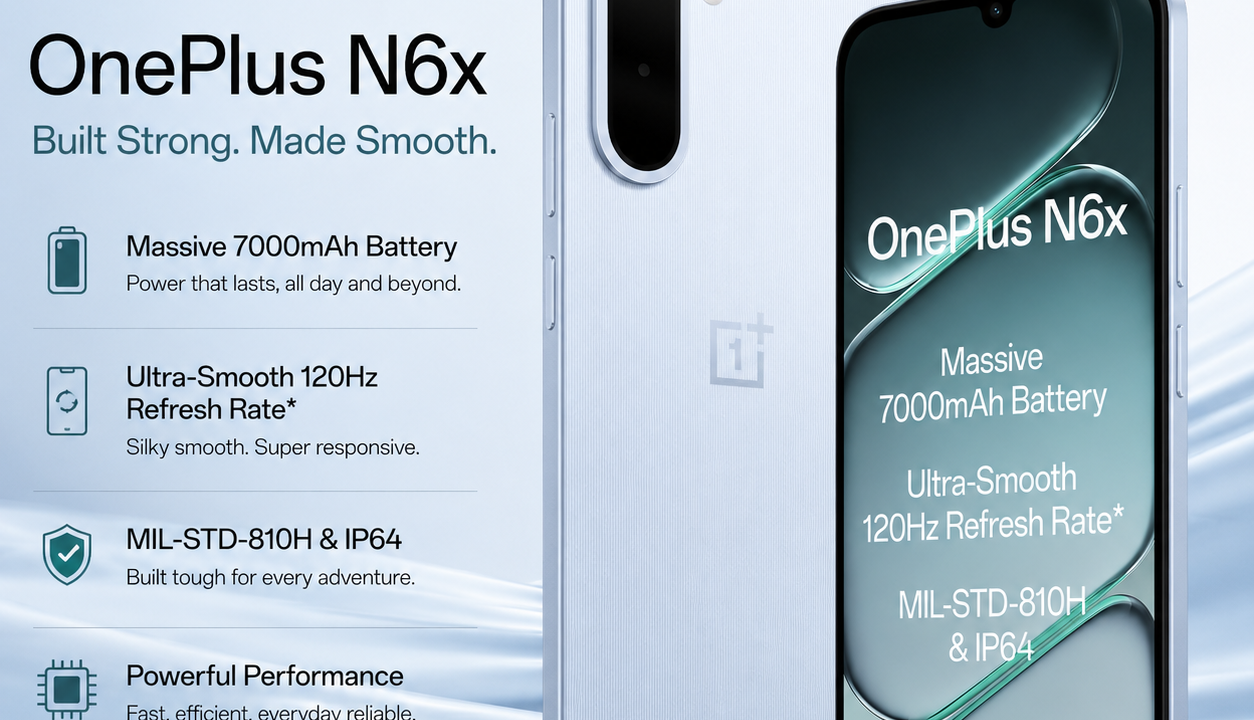
According to official specifications, the OnePlus N6x measures 166.38 x 78.13 x 8.65 mm and weighs 214 grams. It features a plastic back and frame with Armorshell Glass on the front. The device carries both MIL-STD-810H military-grade shock resistance and IP64 dust and splash resistance. OnePlus markets the N6x with the tagline “Built Strong. Made Smooth,” and the hardware appears to back that claim. The dedicated microSD slot alongside dual nano-SIM support is a practical touch for users who need expandable storage without sacrificing the second SIM.
The OnePlus N6, on the other hand, is slightly thicker and heavier at 224 grams with dimensions of 166.47 x 78.23 x 8.88 mm. It also features a polycarbonate body but steps up to IP65 certification, offering better protection against low-pressure water jets compared to the N6x’s IP64 rating. The N6 includes an IR Blaster — a feature absent on the N6x — which allows users to control TVs and AC units directly from the phone. However, the N6 drops the 3.5mm headphone jack, while the N6x retains it.
Both phones are available in dual-tone colour options. The N6x comes in Burgundy Red and Ice Blue, while the N6 is offered in Fresh Mint and Midnight Green. On paper, the N6x has the edge in weight and includes a headphone jack, but the N6 offers superior water resistance and the IR Blaster utility. Advantage — Design: OnePlus N6 (better IP rating and IR Blaster slightly outweigh the missing headphone jack for most users).
Display Comparison
Both the OnePlus N6x and OnePlus N6 feature identical 6.8-inch IPS LCD panels with a resolution of 720 x 1570 pixels, a 19.5:9 aspect ratio, and a 120Hz refresh rate. According to official specifications, the N6x reaches up to 700 nits typical brightness and 900 nits in High Brightness Mode (HBM). The N6 pushes further with 975 nits typical and 1200 nits HBM, making it noticeably brighter under direct sunlight. Both displays support the same 254 ppi pixel density, which is adequate for the HD+ resolution at this screen size.
The 120Hz refresh rate on both models ensures smooth scrolling and responsive touch input. However, neither display supports LTPO adaptive refresh rate technology, meaning the 120Hz runs at a fixed rate rather than dynamically adjusting to save power. Both panels are flat rather than curved, which is a practical choice at this price point. The N6’s higher peak brightness gives it a meaningful edge for outdoor visibility. Advantage — Display: OnePlus N6 (significantly brighter panel with 1200 nits HBM vs 900 nits).
Performance — Dimensity 6360 Apex vs Dimensity 6360 Apex
Both smartphones are powered by the same MediaTek Dimensity 6360 Apex chipset built on a 6nm process. The octa-core CPU consists of 2x Cortex-A76 cores clocked at 2.4 GHz and 6x Cortex-A55 cores at 2.0 GHz, paired with a Mali-G57 MC2 GPU. According to official benchmark data, the OnePlus N6 (6GB variant) scores approximately 605,149 on AnTuTu v10, while the N6x scores around 531,619 to 577,250 depending on the testing source. The performance gap is primarily due to RAM configuration — the N6 offers a 6GB RAM option, while the N6x is capped at 4GB.
Both devices run Android 16 with OxygenOS 16. OnePlus claims the N6 delivers a 60-month smooth experience on the 6GB variant and 48 months on the 4GB variant. The N6x offers 48-month smoothness for the 128GB variant and 36 months for the 64GB variant. Both phones support RAM expansion technology, but the N6’s higher base RAM gives it better multitasking headroom. The N6 also benefits from a larger 5300mm2 vapor chamber cooling system, whereas the N6x relies on a standard cooling solution.
For everyday tasks, social media, and light gaming, both phones perform similarly. However, the N6’s 6GB RAM option and superior thermal management make it the better choice for power users. Advantage — Performance: OnePlus N6 (6GB RAM option and better cooling give it a clear edge).
Battery Life, Charging & Connectivity
Battery capacity is where these two devices diverge most dramatically. The OnePlus N6 packs an 8000 mAh battery — the segment’s largest, according to OnePlus — paired with 45W SuperVOOC fast charging. The manufacturer claims the N6 can deliver up to 3 days of power on a single charge under typical usage conditions. A 5-minute charge reportedly provides 1.7 hours of YouTube playback. The N6 also supports 5W reverse wired charging and bypass charging for gaming sessions.
The OnePlus N6x houses a 7000 mAh battery with 15W wired charging. OnePlus claims up to 2.5 days of battery life per charge. The N6x also includes a Battery Health Engine that promises to retain approximately 80% capacity even after 6 years of use. However, the 15W charging speed is significantly slower — charging from 20% to 100% takes approximately 2 hours and 31 minutes according to published test data. The N6x also supports 5W reverse wired charging and bypass charging.
In connectivity, both phones support 5G, dual-band Wi-Fi, Bluetooth 5.4, GPS, and USB Type-C 2.0 with OTG. The N6x includes a 3.5mm headphone jack, while the N6 does not. The N6x also offers a dedicated microSDXC slot, whereas the N6 uses a hybrid SIM slot for expansion. Advantage — Battery & Charging: OnePlus N6 (1000 mAh more capacity and 3x faster charging). Advantage — Connectivity: OnePlus N6x (3.5mm jack and dedicated microSD slot).
Final Verdict — Which Should You Buy?
|
🏆 Buy OnePlus N6x If
|
📋 Buy OnePlus N6 If
|
The OnePlus N6x is the ideal choice for budget-conscious buyers who want a reliable 5G smartphone with exceptional battery life, military-grade durability, and essential features like a headphone jack and expandable storage. At Rs.18,999, it delivers remarkable value in the entry-level 5G segment. However, the compromises in camera quality, charging speed, and RAM capacity are noticeable.
The OnePlus N6, priced at Rs.22,998 for the 4GB variant and Rs.24,998 for the 6GB variant, justifies its premium with a significantly larger 8000 mAh battery, 45W SuperVOOC fast charging, a superior 50MP camera, a brighter display, and the option for 6GB RAM. For users who can stretch their budget by Rs.4,000–Rs.6,000, the N6 offers a more complete and future-proof package. Based on the hardware configuration and official specifications, the OnePlus N6 emerges as the overall winner in this comparison.
|
OnePlus N6x 7.8 / 10 Best Budget 5G Value |
OnePlus N6 8.4 / 10 Best Overall Pick |
| 🛒 Buy OnePlus N6x | 🛒 Buy OnePlus N6 |
📄 Also Read: OnePlus N6 vs Redmi Turbo 5 (2026) — See how the OnePlus N6 stacks up against Xiaomi’s budget champion in this detailed comparison.
Affiliate Disclosure: This post contains affiliate links. If you purchase through these links, we may earn a small commission at no extra cost to you.
Content Disclosure: This content was produced with AI assistance and human review to ensure accuracy, fairness, and helpfulness for our readers.