
- MediaTek Dimensity 9400e vs Snapdragon 8s Gen 4: Which Processor Is Better? (2026)
- Quick Specs Comparison
- CPU Performance: Four X4 Cores vs One X4 Core
- GPU and Gaming Performance: Adreno 825 vs Mali-G720 Immortalis
- Thermal Efficiency and Battery Life
- AI and NPU Capabilities
- Camera and Multimedia Features
- Connectivity: 5G, Wi-Fi, and Bluetooth
- Which Processor Should You Choose?
- Frequently Asked Questions
- Conclusion
Technology | Information | 2026
MediaTek Dimensity 9400e vs Snapdragon 8s Gen 4: Which Processor Is Better? (2026)
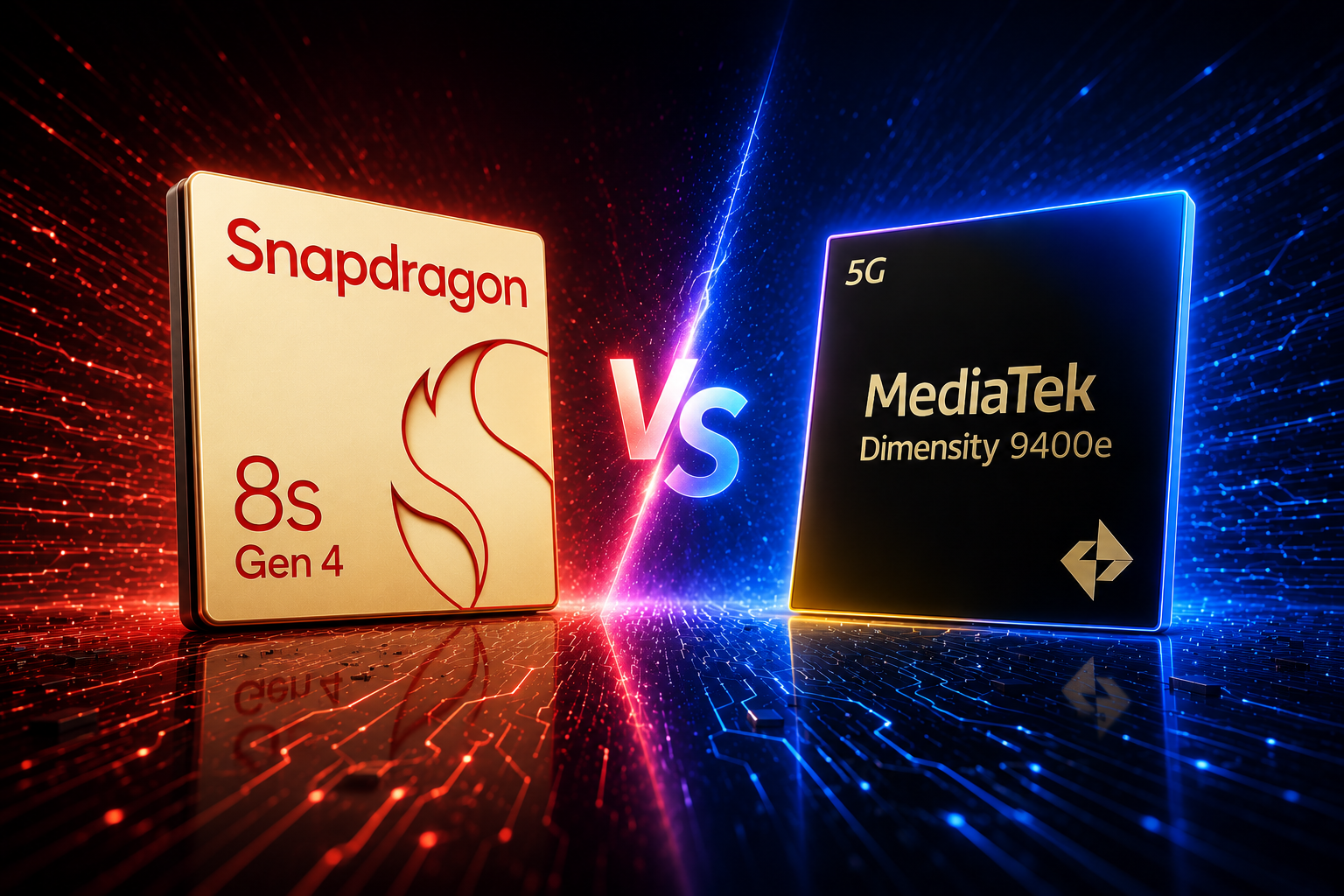
MediaTek Dimensity 9400e vs Snapdragon 8s Gen 4 is the most talked-about chipset battle in India for 2026. Both processors target the premium mid-range segment priced between ₹30,000 and ₹45,000, yet they offer near-flagship performance. Qualcomm’s Snapdragon 8s Gen 4 brings a refined Adreno GPU and proven software ecosystem, while MediaTek’s Dimensity 9400e pushes aggressive CPU core counts and superior thermal efficiency.
In this detailed comparison, you will learn how these two chips differ in CPU and GPU benchmarks, real-world gaming, AI capabilities, battery efficiency, and camera features. If you are planning to buy a flagship-killer smartphone in 2026 and confused between Snapdragon and MediaTek, this guide will help you make the right decision.

Quick Specs Comparison
| Specification | Snapdragon 8s Gen 4 | Dimensity 9400e |
|---|---|---|
| Process Node | 4nm (TSMC) | 4nm (TSMC) |
| CPU Cores | 8 (1x X4 3.21GHz + 3x A720 3.0GHz + 2x A720 2.8GHz + 2x A720 2.02GHz) | 8 (1x X4 3.4GHz + 3x X4 2.85GHz + 4x A720 2.0GHz) |
| GPU | Adreno 825 | Mali-G720 Immortalis MP12 |
| AnTuTu v11 Score | ~2,105,193 | ~2,123,428 |
| Geekbench 6 Single | ~2,074 | ~2,208 |
| Geekbench 6 Multi | ~6,651 | ~7,310 |
| GPU FLOPS | 2,355 Gigaflops | 3,994 Gigaflops |
| RAM Support | LPDDR5X up to 4.8GHz, 24GB max | LPDDR5X up to 4.8GHz, 24GB max |
| Storage | UFS 4.0 | UFS 4.0 |
| 5G Download Speed | Up to 4.2 Gbps | Up to 7.3 Gbps |
| Wi-Fi | Wi-Fi 7 (peak 5.8 Gbps) | Wi-Fi 7 (peak 7.3 Gbps) |
| Bluetooth | 6.0 | 6.0 |
| NPU / AI | Qualcomm Hexagon (Generative AI, LLMs) | MediaTek NPU 790 (Multi-Modality, LVM, LLM) |
| Max Camera | 320MP single | 320MP single |
| Video Recording | 4K at 60fps | 8K at 30fps, 4K at 60fps |
| Display Support | UHD at 144Hz | UHD at 180Hz |
CPU Performance: Four X4 Cores vs One X4 Core
The MediaTek Dimensity 9400e dominates CPU benchmarks thanks to its aggressive core configuration. With four Cortex-X4 cores — one at 3.4GHz and three at 2.85GHz — it achieves a Geekbench 6 multi-core score of approximately 7,310, which is about 10% higher than the Snapdragon 8s Gen 4’s score of around 6,651. In single-core tests, the Dimensity 9400e scores roughly 2,208 compared to the Snapdragon’s 2,074.
The Snapdragon 8s Gen 4 uses a more conservative 1+3+2+2 cluster with only one Cortex-X4 prime core at 3.21GHz, paired with seven Cortex-A720 cores. While this design is more thermally efficient, it cannot match the raw multi-threaded power of the Dimensity 9400e’s four X4 cores. For heavy multitasking, video editing, and demanding applications, the Dimensity 9400e is the clear winner.
ℹ️ Did You Know: The Dimensity 9400e’s four Cortex-X4 cores are a flagship-grade configuration rarely seen outside premium chips. MediaTek brought this architecture to the upper-mid-range segment, giving it a massive CPU advantage over competitors.
⭐ Key Point: In AnTuTu v11, the Dimensity 9400e scores approximately 2,123,428 versus the Snapdragon 8s Gen 4’s 2,105,193 — a narrow 0.8% lead overall. However, the CPU sub-score gap is much wider at around 9.5%, showing where the real difference lies.
GPU and Gaming Performance: Adreno 825 vs Mali-G720 Immortalis
The GPU battle is closer than the CPU comparison. The Dimensity 9400e’s Mali-G720 Immortalis MP12 delivers approximately 3,994 Gigaflops — significantly higher than the Adreno 825’s 2,355 Gigaflops on paper. In 3DMark Wild Life Extreme, the Dimensity 9400e scores around 5,247 compared to the Snapdragon 8s Gen 4’s 3,499. In GFXBench Aztec 1440p, the Dimensity 9400e hits 96 FPS versus the Snapdragon’s 90 FPS.
However, the Snapdragon 8s Gen 4 shows better GPU stability in sustained workloads. In 3DMark Wild Life Extreme Stress Test, the Snapdragon maintains 77.5% stability compared to the Dimensity 9400e’s 68.3%. This means the Adreno 825 throttles less during extended gaming sessions, delivering more consistent frame rates over time. For games like BGMI, both chips perform similarly — the realme GT 7 (Dimensity 9400e) averages 118.2 FPS while the iQOO Neo 10 (Snapdragon 8s Gen 4) averages 116.8 FPS.
ℹ️ Did You Know: The Snapdragon 8s Gen 4 supports 144 FPS frame interpolation for BGMI and Genshin Impact through Qualcomm’s Elite Gaming features, while the Dimensity 9400e relies on MediaTek’s HyperEngine for similar optimizations.
Thermal Efficiency and Battery Life
Despite its higher performance, the Dimensity 9400e runs surprisingly cooler than the Snapdragon 8s Gen 4. In real-world gaming tests, the realme GT 7 with Dimensity 9400e maintained an average temperature of 37.6°C during Wuthering Waves, while the iQOO Neo 10 with Snapdragon 8s Gen 4 reached 40.4°C. During BGMI, the Dimensity 9400e stayed at 38.7°C versus the Snapdragon’s 43.9°C.
In the 15-minute CPU Throttling Test, the Dimensity 9400e maintained 76% of its peak performance — better than many flagship chips. This superior thermal management translates to longer gaming sessions without performance drops. For Indian summers where ambient temperatures often exceed 35°C, the Dimensity 9400e’s cooler operation is a significant practical advantage.
⭐ Key Point: The Dimensity 9400e achieves higher performance while drawing less power than both the Snapdragon 8s Gen 4 and even the Snapdragon 8 Gen 3. This efficiency advantage means better battery life during intensive tasks.
AI and NPU Capabilities
Both chips bring flagship-level AI to the mid-range segment. The Snapdragon 8s Gen 4 features Qualcomm’s Hexagon NPU, which is 44% faster than its predecessor with 2x larger shared memory. It supports on-device generative AI, large language models, and real-time semantic segmentation for photos and videos with up to 250 layers.
The Dimensity 9400e counters with MediaTek’s NPU 790, which supports multi-modality large models, vision models, and speculative decoding for faster AI responses. It also supports DeepSeek-R1-Distill models and Gemini Nano with multimodality. In Geekbench 6 GPU Compute (Vulkan), the Snapdragon 8s Gen 4 scores 18,816 compared to the Dimensity 9400e’s 15,417 — showing Qualcomm’s strength in AI compute tasks.

Camera and Multimedia Features
Both chipsets support up to 320MP single cameras and feature 18-bit ISPs. The Dimensity 9400e edges ahead with 8K video recording at 30fps compared to the Snapdragon 8s Gen 4’s 4K at 60fps. For content creators who shoot high-resolution video, this is a meaningful difference. The Snapdragon 8s Gen 4 counters with Dolby Vision HDR recording and support for FHD slow-motion at 480fps.
In display support, the Dimensity 9400e supports refresh rates up to 180Hz while the Snapdragon 8s Gen 4 maxes out at 144Hz. Both support UHD resolution and 10-bit color depth. For Indian users who primarily consume content on their phones, both chips deliver excellent visual experiences with support for HDR10, HDR10+, and HLG formats.
Connectivity: 5G, Wi-Fi, and Bluetooth
The Dimensity 9400e leads in connectivity with 5G download speeds up to 7.3 Gbps — significantly higher than the Snapdragon 8s Gen 4’s 4.2 Gbps. Over Wi-Fi 7, the Dimensity 9400e peaks at 7.3 Gbps versus the Snapdragon’s 5.8 Gbps. For Indian users on Jio and Airtel 5G networks, this means faster downloads and better network performance in areas with strong coverage.
Both chips include Bluetooth 6.0 and support for all major navigation systems including GPS, GLONASS, Beidou, Galileo, QZSS, and NAVIC. The Snapdragon 8s Gen 4 uses Qualcomm’s X75 modem while the Dimensity 9400e uses MediaTek’s integrated 5G R16 modem. Both support sub-6GHz 5G bands used in India.
⭐ Key Point: MediaTek’s Xtra Range 3.0 technology extends Wi-Fi coverage by up to 30 meters, which is particularly useful in large Indian homes where router signals often struggle to penetrate thick walls.
Which Processor Should You Choose?
Your choice depends on your priorities. Here is a clear breakdown for Indian buyers in 2026:
| Choose Dimensity 9400e If | Choose Snapdragon 8s Gen 4 If |
|---|---|
| Maximum CPU performance is your priority | You want better GPU stability over time |
| You want cooler temperatures during gaming | 144 FPS frame interpolation matters to you |
| 8K video recording is important | You prefer Qualcomm’s software ecosystem |
| Faster 5G and Wi-Fi speeds appeal to you | Dolby Vision HDR recording is a must |
| You value thermal efficiency and battery life | You want consistent long-term software support |
📄 Also Read: Snapdragon 7 Gen 4 vs MediaTek Dimensity 9400e — 2026 Comparison — See how the lower-tier Snapdragon 7 Gen 4 compares against the Dimensity 9400e for budget-conscious buyers.
Frequently Asked Questions
Q: Is the Dimensity 9400e better than Snapdragon 8 Gen 3?
A: The Dimensity 9400e outperforms the Snapdragon 8 Gen 3 in multi-core CPU benchmarks and GPU tests. In Geekbench 6, the Dimensity 9400e scores around 7,310 multi-core versus the Snapdragon 8 Gen 3’s approximately 7,421 — very close. However, the Dimensity 9400e runs cooler and more efficiently, making it the better choice for sustained performance.
Q: Which phones in India use the Snapdragon 8s Gen 4?
A: As of mid-2026, the iQOO Neo 10, POCO F7, OnePlus Nord 6, OPPO K13 Turbo Pro, and Nothing Phone 3 feature the Snapdragon 8s Gen 4 in India. These phones are priced between ₹29,999 and ₹45,999, targeting the premium mid-range segment.
Q: Does the Dimensity 9400e overheat during gaming?
A: No, the Dimensity 9400e actually runs cooler than the Snapdragon 8s Gen 4 during gaming. In tests, it maintained temperatures 3-5°C lower than the Snapdragon while delivering higher frame rates. MediaTek’s thermal optimized package design and efficient 4nm process contribute to this advantage.
Q: Which chip gets better software updates?
A: Snapdragon chips generally receive longer and more consistent software support due to Qualcomm’s broader developer ecosystem and closer partnerships with Google. However, MediaTek has improved significantly, and major brands like OnePlus and realme now offer 3-4 years of updates for Dimensity-powered phones.
Q: Is the AnTuTu score difference significant between these two chips?
A: The AnTuTu difference is only about 0.8% — essentially negligible in real-world use. However, the Dimensity 9400e’s CPU sub-score is approximately 9.5% higher, which translates to faster app launches and better multitasking. The Snapdragon 8s Gen 4 leads slightly in GPU and memory scores.
Conclusion
The MediaTek Dimensity 9400e emerges as the overall winner in this comparison. It delivers superior CPU performance, better GPU raw power, cooler temperatures, faster connectivity, and excellent thermal efficiency — all while matching or exceeding the Snapdragon 8s Gen 4 in most benchmarks. For power users, gamers, and content creators, the Dimensity 9400e offers flagship-grade performance at a mid-range price.
The Snapdragon 8s Gen 4 remains a strong contender for users who prioritize GPU stability, Qualcomm’s software ecosystem, and features like Dolby Vision recording. It is also the better choice if you value 144 FPS gaming interpolation and consistent long-term software support. In the Indian market, both chips power excellent smartphones, and your final decision should depend on which brand and specific phone model appeals to you most.
Content Disclosure: This content was produced with AI assistance and human review to ensure accuracy, fairness, and helpfulness for our readers.